Marbles were for Keeps: A 1950’s Recess Ritual at S.J. Miller Elementary
Before screen time and organized after-school programs, recess in the 1950s was a battleground of skill, luck, and pride. At S.J. Miller Elementary School, playing marbles wasn’t just child’s play—it was a serious, high-stakes tradition. This memory ties directly into the school-day atmosphere described in “My Elementary School,” a chapter from The Ghosts of Shaw Mines, where youthful routines, classroom dynamics, and playground hierarchies were carved as deeply as initials in a school desk.
Marbles were for Keeps
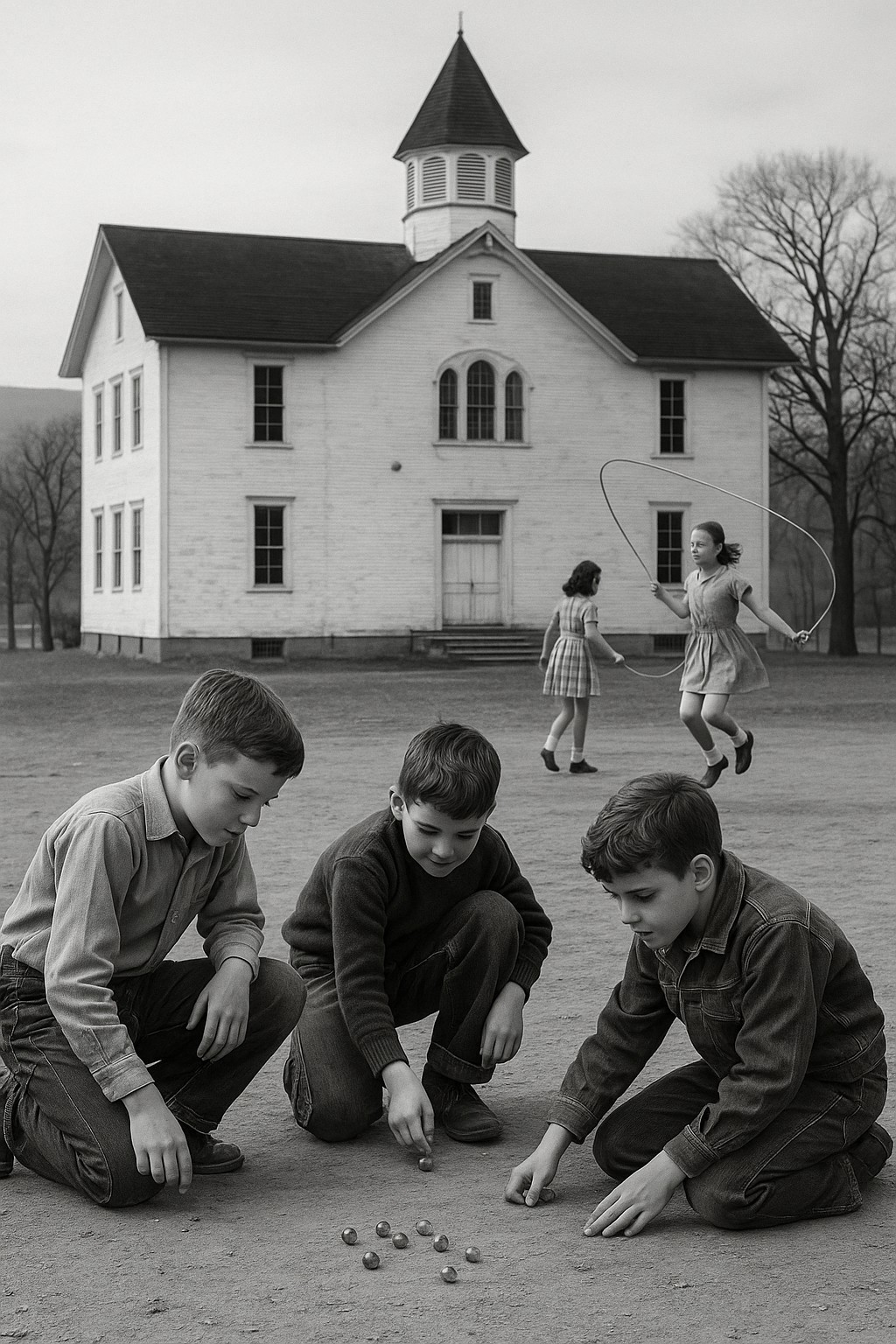
At S.J. Miller Elementary, lunchtime and recess were prime times for marbles—a game played in the dirt, strictly by the boys, while the girls claimed the nearby sidewalk with rhythmic rope-skipping. The unspoken code was clear: no one played marbles just for fun. Marbles were for keeps.
We’d draw a circle about three feet wide in the packed schoolyard dirt. Each boy placed a few marbles in the center, then crouched outside the ring and aimed his shooter. A solid flick would send an opponent’s marble flying—and the victor got to keep it.
There were rules, and one of them mattered more than any other: No Hunching. If your shooting hand crept past the edge of the circle, you lost your turn. Repeat offenders risked more than just a scolding. A heated dispute over hunching could escalate to blows, and plenty did.
The Currency of the Playground
Marbles came in a dazzling variety. There were the coveted Glassies—especially Cat’s Eyes, with their mysterious swirl of color trapped in glass. And then there were Commies, plain clay marbles often considered second-class. Commies weren’t even allowed in the ring’s center—too cheap, too small.
Most boys had a favorite Shooter marble—large, heavy, and often kept for years. Shooters were off-limits for claiming. Everything else was fair game.

When the school bell rang, games ended abruptly. Winners walked away triumphantly, their pockets bulging with the day’s haul. But sometimes, the marbles betrayed them—spilling across the classroom floor mid-lesson, rolling under desks and drawing a stern look from the teacher. Confiscation was inevitable.
Easy Come, Easy Go
It was a lesson in luck, rivalry, and unspoken justice. And like so many parts of 1950s childhood, the marbles game left its mark—not just in scuffed jeans and dusty fingers, but in a sense of honor that followed many of us long after we left S.J. Miller behind.
You’ll find the roots of this playground pride woven through The Ghosts of Shaw Mines, especially in “My Elementary School,” where friendships were tested, identities formed, and marbles… well, marbles were for keeps.
© 2025 Clyde Housel. All rights reserved.
This work may not be reproduced, distributed, or transmitted in any form without prior written permission from the author, except for brief quotations in reviews or scholarly works.