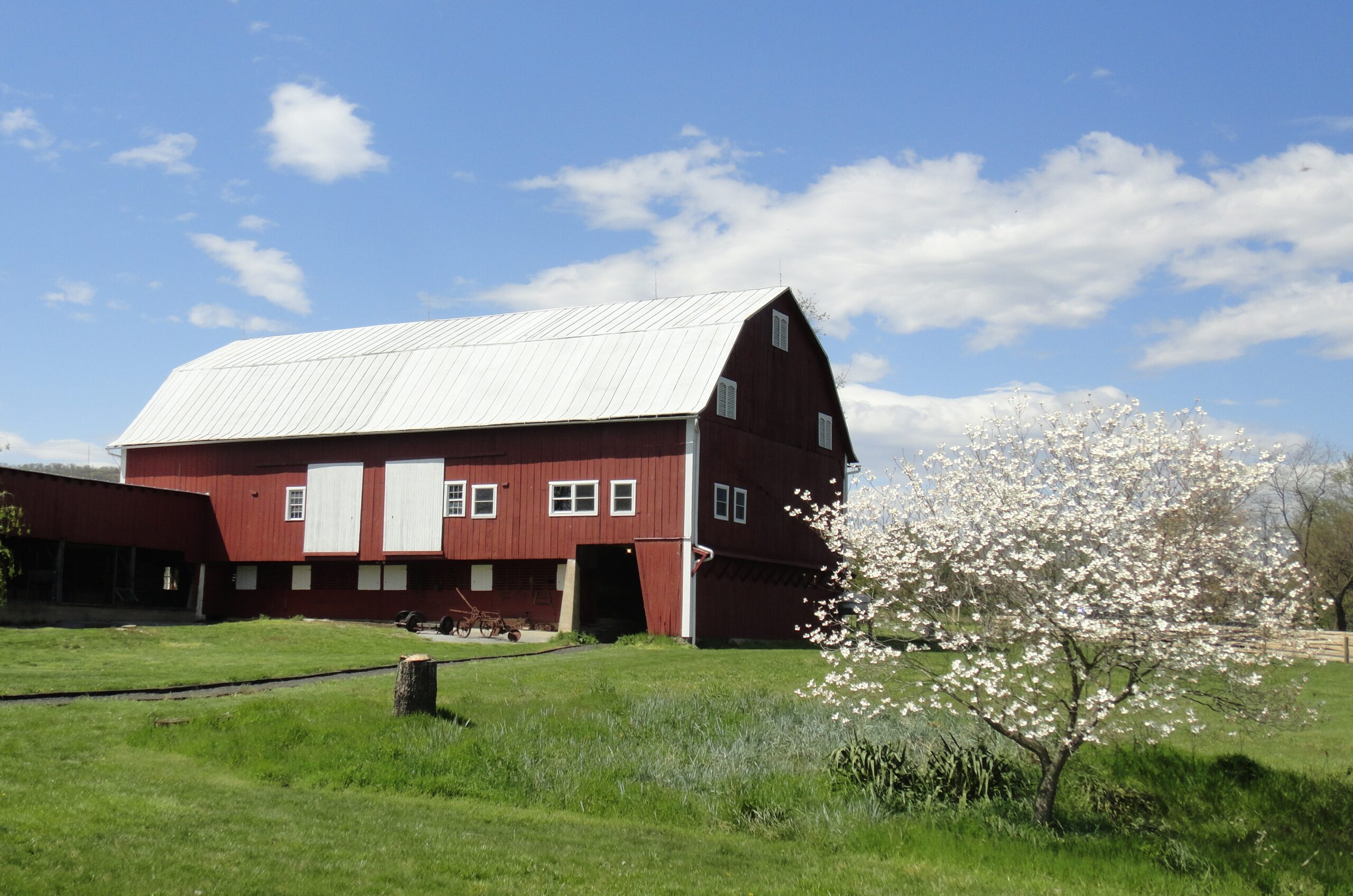
Rebuilding the Barn at the Compher Farm after the Tornado of 1929
The Storm that Shook Loudoun County
On May 2, 1929, an unusual outbreak of five tornadoes touched down across the foothills of western Loudoun County, Virginia. The storm carved a path of destruction from north of Hamilton through Waterford and beyond, leaving twisted timber, shattered windows, and families reeling in its wake.
Among the hardest hit was the John W. Compher farm.
Witnesses described the aftermath with awe and horror—barns flattened, trees peeled like bananas, and equipment scattered like toys. Editor Arthur Lybolt of the Blue Ridge Herald reported that structures looked “as if a giant had taken a hammer and beaten everything flat.”
The tornado destroyed the Compher’s barn, but the farm was not lost.
The Ledger Tells the Story
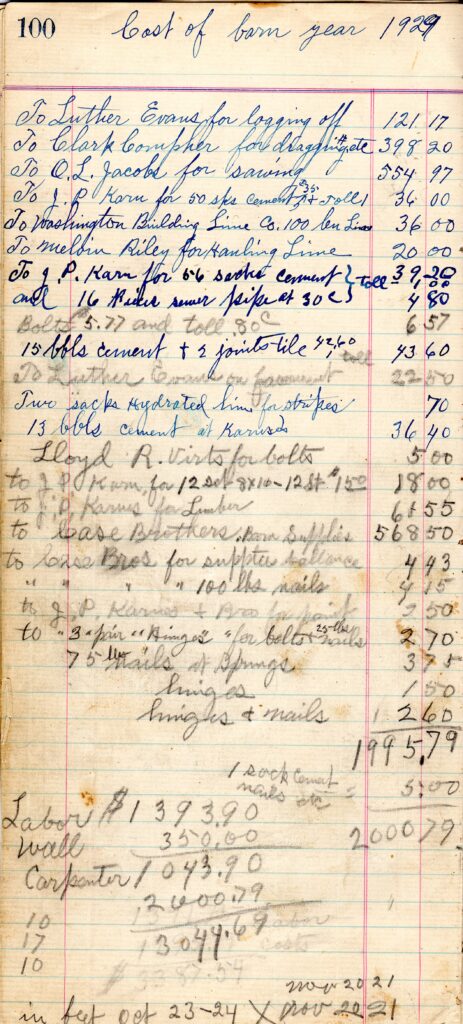
A single surviving page from the Compher family’s farm ledger offers an intimate look at how the family put their lives—and their barn—back together.
The first expenses recorded in May 1929 show the urgent task of clearing the wreckage:
- Logging by Luther Evans: $121.17
- Dragging lumber (Clark Compher): $398.20
- Sawing lumber (O. L. Jacobs): $554.97
With the debris removed and lumber prepared, construction began. Cement and lime—critical for laying a strong new foundation—were sourced from J. P. Karn and Washington Building Lime Co., with tolls paid to transport them along rough country roads. A sample of purchases includes:
- 50 sacks cement: $36.00
- 100 bushels lime: $36.00
- Additional cement, sewer pipe, bolts, joint tiles, and hydrated lime for whitewashing
Raising a New Barn
As the ledger entries progress, we witness a full-scale rebuild unfold:
- Barn Supplies (Case Bros.): $568.50
- 12 sets of 8x10x12” lumber: $18.00
- Lumber and hardware: $61.55
- 100 lbs of nails: $4.15
- Hinges and fittings: $12.05
- Carpenter labor: $1,043.90
Each nail, beam, and bolt was carefully accounted for—a family working not just from muscle and memory, but from the discipline of good recordkeeping. It wasn’t just a barn being rebuilt; it was a life’s work restored.
The Spirit of Resilience
In today’s dollars, the Compher family’s rebuilding efforts totaled over $55,000—a monumental sum for 1929, especially on the eve of the Great Depression. But they succeeded, stone by stone and board by board.
Neighbors helped. Lumber was milled. Lime was hauled by wagon. And when the dust settled, a new barn stood on the land where generations had toiled before.
The tornado may have taken the barn, but it could not take the will to rebuild. That spirit still echoes through the hills of Lovettsville and Waterford—a legacy we honor every time we walk among these fields.
But…There is More to this Story
This tornado that struck Loudoun County, Virginia—including the John W. Compher farm—on May 2, 1929, was part of the same broader tornado outbreak system known historically as the Rye Cove Tornado Outbreak.
- The Rye Cove Tornado Outbreak occurred on May 2, 1929 and is named after the deadly F3 tornado that struck Rye Cove, Virginia, in Scott County, killing 13 schoolchildren and a teacher.
- However, the Rye Cove tornado was just one of at least 17 tornadoes that touched down across multiple states, including Virginia, Maryland, West Virginia, and parts of the Midwest and South.
- On the same day, multiple tornadoes hit western Loudoun County (including Waterford and Hamilton). Contemporary newspaper reports and historical analyses confirm that five tornadoes touched down in Loudoun County alone, including the one that destroyed the Compher barn.
So in summary:
Yes—the tornado that destroyed the Compher barn was part of the larger May 2, 1929 outbreak system, commonly referred to in historical accounts as the Rye Cove Tornado Outbreak. Though the Loudoun County tornadoes are less well-known than the Rye Cove disaster, they occurred on the same day, under the same meteorological conditions, and as part of the same severe weather event.
© 2025 Terry Housel. All rights reserved.
This work may not be reproduced, distributed, or transmitted in any form without prior written permission from the author, except for brief quotations in reviews or scholarly works.