Buzzards on the Deck – A Fowl Situation
How Buzzards took our Barn and Sanity
We’ve lived on our property since 1989, and for most of that time, our co-existence with buzzards has been peaceful. When my husband takes table scraps outside, buzzards somehow know, immediately. Before he is back in the house, they swoop in ready for the buffet. We see them roosting in the tree line behind our home. Or occasionally we see a group of them performing their sacred duty as nature’s carrion custodians. When they do this, they are known as a “wake”.
Sometimes, while working outdoors, we lie down in the grass for a breather and notice them circling high in the sky above us. Clearly, they are just waiting. No harm, no foul. By the way: did you know that a group of buzzards circling in the sky, is called a “kettle”?
Regardless, our peaceful coexistence was eventually breached.
Our Deck Became a Buzzard Spa
Our buzzard battle began in 2011, shortly after we purchased the adjoining parcel that includes the farmhouse, three log buildings, and the bank barn. That addition turned out to be a game changer…and not in the way we expected.
A squadron of buzzards decided that our tasting house deck was the perfect place to practice yoga, or more specifically, sun salutations. Every morning, half a dozen vultures would line up like winged laundry racks, holding their “horaltic poses” in eerie silence as they blessed the sunrise with their ominous presence.
They also barfed.
And pooped.
With reckless abandon.
As if that weren’t enough, they pecked out the screens on both the front and back tasting room windows. My theory? They saw their own reflections in the glass and mistook them for rivals…so, basically, a bar fight. Or maybe they just wanted to be first in line for Unhappy Hour.
We had to deep clean the deck every single day before the tasting room opened. It became routine: upon waking we immediately peered out the window. If buzzards were lined up like bored bar patrons, Clyde would jump in the pickup truck. He’d drive straight at them, horn blaring like he was late for church, and they were blocking the aisle. They’d flap off, slow and sullen, just like goth teenagers asked to turn down their music.
But they always returned.

The Buzzards Strike Back
Buzzards, you see, don’t scare easily. They have a union, I swear. We didn’t know it at the time, but we were up against generations of barn-dwelling, deck-defiling, roof-roosting freeloaders who had clearly voted our property Club Med for Vultures.
We enjoy talking with customers during wine tastings. We’ll cover just about any topic under the Sun. However, we didn’t mention any aspect of this bizarre scenario to our customers. Who wants to hear about projectile vulture vomit during a wine tasting? But eventually, we broke down and mentioned the issue to a long-time Loudoun farming resident. He schooled us: buzzards have preferred trees for roosting at night. If we wanted them gone, we had to find their trees and take them down.
All we wanted were un-pecked window screens, unsullied deck furniture, and a sunrise that didn’t feature black silhouettes relieving themselves on the horizon.
The Roosting Tree Reckoning
A twilight vigil began. Every evening, we sat on the tasting house porch and watched as buzzards streamed into Hiddencroft Vineyards from all points of the compass. They glided in like feathered aircraft returning to base.
The epicenter of this nightly invasion was the tallest and oldest tree on the property—a long-dead White Oak that stood directly behind the tasting house. It was a towering relic, ghostly and grand. Deep in its trunk was a rusted chain, nearly swallowed by bark over the decades. A member of the Compher family once told us that his grandfather had looped that chain around the tree to tether his horse, keeping it from following him down to the springhouse.
One evening, we counted more than a hundred buzzards roosting in that White Oak and a couple of the neighboring trees. The scene was both majestic and unnerving.
Those trees were massive and beautiful, but they had become host to a problem we couldn’t ignore. Because of their size and proximity to our buildings, we had them taken down professionally.
That evening, the buzzards circled in and found… nothing. They were stunned. You could see the confusion in their wingbeats. It took a few days for them to process the loss, but eventually, they moved on.
Well, most of them. A dozen or so lingered for years. They left the deck and window screens alone. We accepted them.
Away in the Manger
Years later, we noticed a committee lingering near the barn. We often saw them perched on the smokehouse or just hanging around in random trees. Or suspiciously flying into and out of the underside of the barn, repeatedly. One day, Clyde wandered into the bottom of our old bank barn and found a scraggly little buzzard family—turkey vultures, if you’re being formal. They were hunkered down like they’d signed a lease.
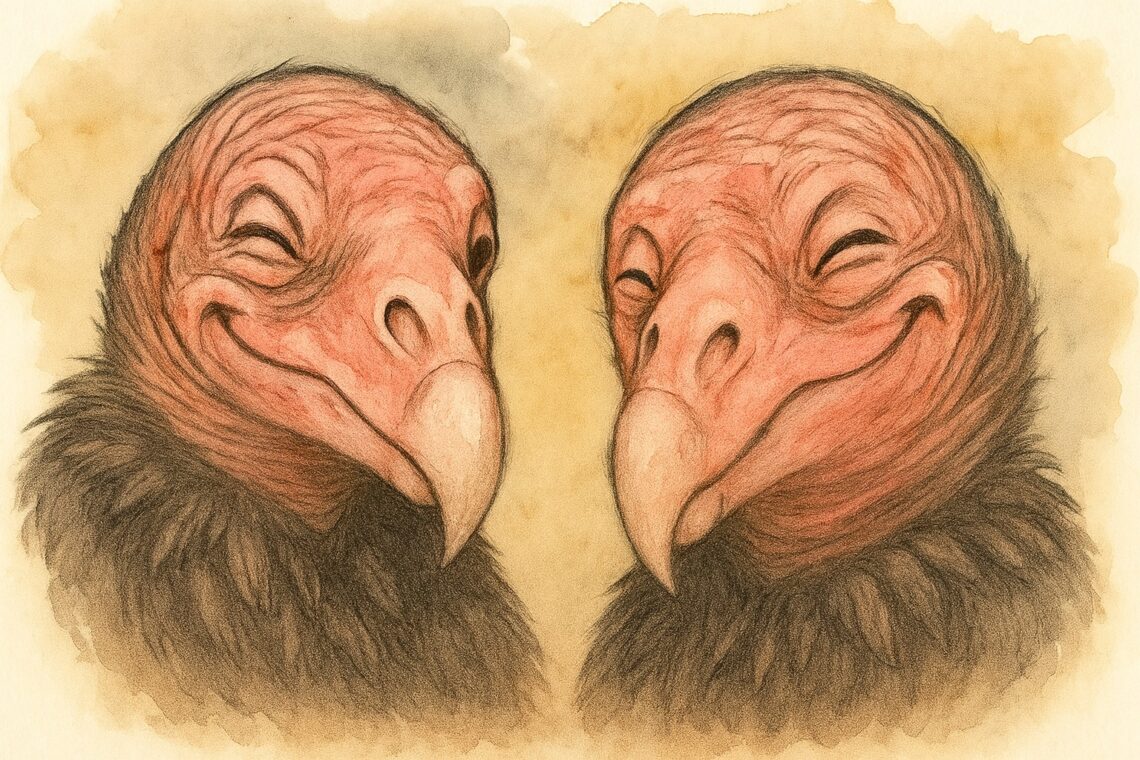
In the manger were two gangly, pink-headed chicks. They looked like plucked chickens crossed with disgruntled gremlins. Flightless and bold, they hissed at my husband with the entitlement of royalty, then waddled away like outraged toddlers.

Flight School: Zero-Radius Edition
We wanted to reclaim the bottom of the barn. It included a machine shed, a dirt-floor manger, and stairs to the upper level. The structure had been wide open to wildlife for years—we already had foxes and groundhogs living like tenants in burrows beneath the manger. We were ready to evict everyone, but it wasn’t an easy job to get them all out at one time.
It took three years to finally close in the bottom of the barn. Clyde played the “steal the eggs” game, but the parents became clever at hiding them. He would see no eggs, but soon would see more chicks. Then began the waiting game for the chicks to grow and take to the skies. He had to learn to hunt smarter. He played many rounds of this game. Eventually we had control of eggs and had just two chicks.
Those buzzard chicks had their own ideas about development. Flying, it turns out, is not a priority for young vultures. I kept seeing what I thought were adult buzzards walking around the property like pedestrians. But they were just teenagers who hadn’t learned how to fly yet.
So, I decided to help.
I began following them with the riding lawnmower, hoping to urge them to use their wings. It became a bizarre mix of dance recital, aerobics class, and bird-herding rodeo. I’d creep behind them, mower humming, and they’d hop indignantly ahead, flapping like underpowered umbrellas in a windstorm. Occasionally, one would stumble into a low, lopsided glide. But it couldn’t gain altitude and go an appreciable distance. I did my best to drive them as far away from the barn as possible, so they would have to walk back…or fly.

Eventually, they figured out that flying was easier than fleeing from a woman on a Kubota Zero-Radius mower. They took off—awkward but airborne. Eventually, we saw them hanging out in trees or on the roof of the barn with the rest of their committee.
We sealed the barn.
Our Buzzards Today
A few still hover overhead. Some perch on the barn roof. They’re like former tenants who swing by the old neighborhood now and then.
They say if you love something, let it go.
We love the barn.
And we let the buzzards go.
We no longer offer the amenities they once enjoyed.
Copyright © 2025 Terry C. Housel
All rights reserved.