Skunks 101 for Naturalists
And Others with Working Noses
Let’s face it: few mammals have inspired more sudden changes of direction, tomato juice baths, or midnight dog disasters than the humble skunk. But behind that odorous reputation lies an impressive, and often endearing, little creature worthy of admiration by even the most seasoned naturalist.
So take a deep breath (well, maybe not too deep), and let’s explore Skunk 101.
Taxonomy and Other Latin Words That Smell Fancy
Skunks belong to the family Mephitidae, which literally means “stink.” That should tell you everything you need to know, but we’re naturalists, so we press on. The striped skunk (Mephitis mephitis meaning Stink stink) is the most widespread species in North America and the only animal that can stop both a bear and a suburban dad in Crocs dead in their tracks.
Other skunk relatives include the spotted skunk (Spilogale putorius or Spotty Weasel of Bad Odor), the hog-nosed skunk, and even the stink badgers of Southeast Asia. You see – I’ve just provided evidence that stink is an international language.
Field Identification: Like a Skunk, But More Obvious
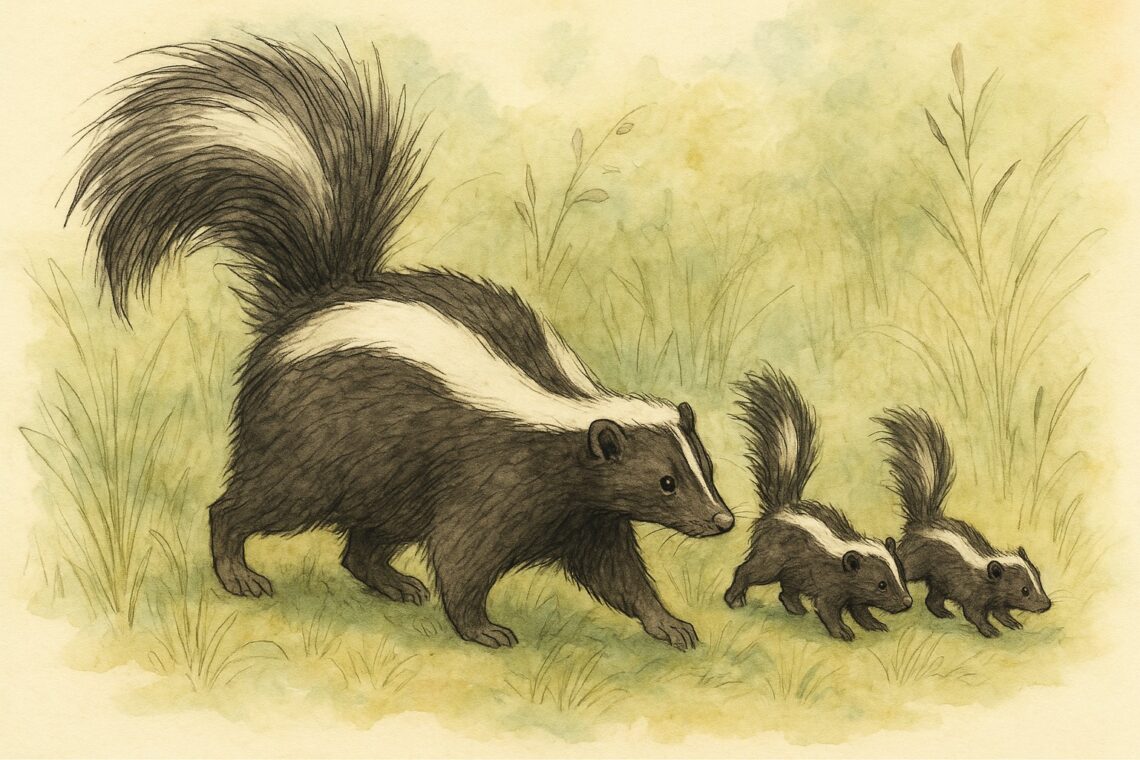
If you see a small, waddling animal with a plume of a tail and a racing stripe, you’ve probably met a skunk. Striped skunks vary in pattern, but the black-and-white coloration is universal and functions as a biological “Beware of Dog” sign. Nature isn’t subtle here.
At night, they often look like a slow-moving toupee, gliding over the ground, on a mission. Their waddling gait, combined with a complete lack of fear, gives them an oddly dignified presence—like a retiree taking out the trash in a bathrobe and slippers.
Behavior and Habitat: The Homebody with Boundaries
Skunks are crepuscular to nocturnal, solitary, and famously non-confrontational unless you force the issue. Which you really, really shouldn’t. They den in hollow logs, under porches, in abandoned burrows, or in that one spot under your shed that your dog is obsessed with. If your home has a crawl space and a skunk can get into it, they will set up housekeeping there as well. There’s nothing like blissfully sleeping in your bed on a cold autumn night, only to awaken to the warm odor of skunk filling all the rooms in your house. You always know when the skunks get home.
Diet-wise, they’re omnivores with a fondness for grubs, insects, berries, small rodents, bird eggs, and whatever leftovers you forgot to put in the trash can. In other words, skunks are the original foragers, predating every hipster with a cast iron skillet.
Skunks can kill chickens, but they are generally considered opportunistic predators rather than calculated poultry assassins. How did we learn this? The Hard Way.
Here’s a breakdown of what to expect:
What Skunks Typically Do Around Chickens:
- They are Egg Thieves First: Skunks are notorious for raiding eggs and chicks. If they can slip into the coop, they’ll often go for the nesting boxes, breaking and eating the eggs on the spot. They’ll also eat very young chicks if they’re easy to catch.
- Adult Chickens? Not Usually. Skunks are small (4–10 lbs), slow-moving, and not designed to take down full-grown chickens. However, they may kill a weak or sleeping hen—especially if startled and acting defensively. Deaths caused by skunks are typically due to neck bites or head injuries.
- They’re not slash-and-dash like raccoons. If your coop looks like a scene from a horror movie, it probably wasn’t a skunk. They are tidier predators, often eating just part of the chicken (especially the head or neck) and leaving the rest.
Signs a Skunk Is the Culprit:
- Faint musky odor near the coop
- Eggs gone or crushed, shells left behind
- Minimal mess
- Wounds to the head/neck area on a chicken
- Dug hole under the coop (skunks are diggers)
How to Protect Your Chickens from Skunks:
- Use hardware cloth, not chicken wire—especially along the bottom of the coop.
- Bury fencing 6–12 inches underground to prevent digging.
- Lock up eggs nightly and collect them regularly.
- Seal up gaps or burrows under sheds, porches, or coops.
- Use motion-activated lights or radios to deter nocturnal visitors.
Final Thought on Chicken Massacres:
Skunks are more scavenger than savage. They’re just doing what nature programmed them to do. But if you have backyard chickens, a secure coop is essential. Think of skunks as the polite burglars of the predator world—they’ll knock before they spray…and usually won’t kill unless they’re very hungry or provoked.
Spray: Nature’s No-Peace Treaty
Ah yes, the infamous spray. A skunk’s primary defense system is two highly calibrated scent cannons located just south of the tail. The spray is a cocktail of sulfur-based compounds that can cause temporary blindness, dry heaving, and social isolation for days.
But here’s the truth: skunks are incredibly reluctant to spray. It’s a last resort, used only when threats are too dumb to heed the warnings. Warning include stomping, tail-lifting, and turning their business end toward you like a loaded bazooka.
Recharging takes time, during which the skunk is basically defenseless. So, unless you’re a predator or an overly curious Labrador Retriever, you’re not in danger unless you ignore all the signs and poke it with a stick (a classic rookie move).
Skunks and the Ecosystem: Pest Control with Flair
Skunks are unsung heroes of pest control. They hoover up grubs, beetles, wasp larvae, and even small rodents—making them beloved by farmers and loathed by beetles. Their digging is minimal and often helpful, aerating soil in search of snacks.
They don’t climb, don’t chase, and don’t bark at the moon. They’re just out there quietly reducing the tick population, making compost disappear, and minding their own business unless you really make it personal.
Field Notes for Naturalists: Respect, Don’t Run
If you encounter a skunk in the wild:
- Stay calm. You are not under attack.
- Do not corner it. Skunks prefer escape over engagement.
- Observe from a respectful distance. With binoculars, not a flashlight and GoPro.
- Don’t offer snacks. You are not Snow White, and that’s a wild animal.
And remember, if you do get sprayed: tomato juice won’t help as much as people say. Try a mixture of hydrogen peroxide, baking soda, and dish soap—then start reevaluating your decision-making processes.
Conclusion: The Striped Philosopher of the Night
Skunks are gentle, resourceful, and oddly charismatic creatures who carry their boundaries on their back. As naturalists, we owe them our admiration, and perhaps a few yards of personal space.
So next time you see a skunk, don’t panic. Tip your hat (metaphorically), give it a wide berth, and say a silent thanks for all the bugs it just took off your property. Then go home and tell your dog not to follow anything with a raised tail.
© 2025 Terry Housel. All rights reserved.
This work may not be reproduced, distributed, or transmitted in any form without prior written permission from the author, except for brief quotations in reviews or scholarly works.