Deeper Lessons Hidden in a Circle of Dirt
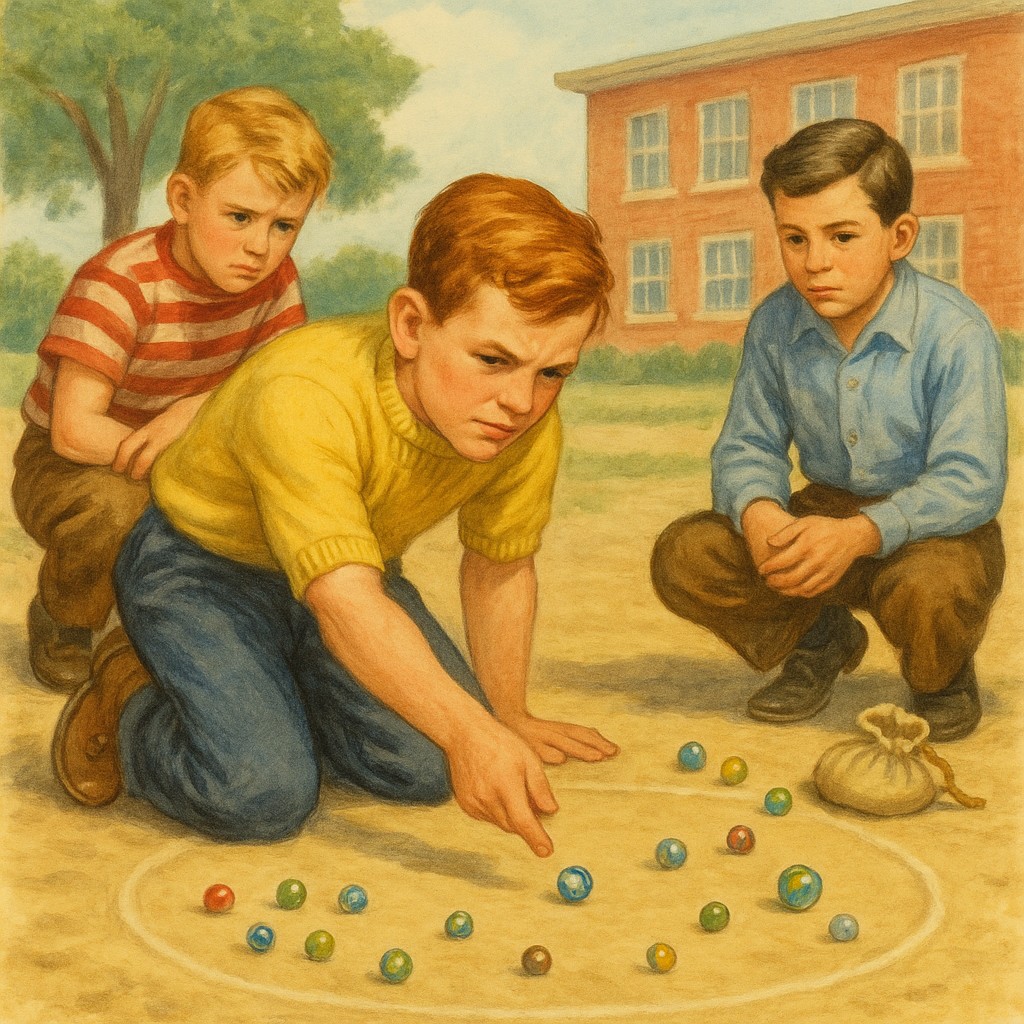
To the casual observer, a game of marbles might seem little more than a dusty schoolyard diversion—children crouched in the dirt, flicking glass spheres with oddly serious expressions. But to those who played it, marbles was never just a game. It was a ritual of risk and reward, a social contract among boys too young to shave but already aware that the world ran on unspoken rules and calculated chances.
At its core, the purpose of playing marbles was transactional. You entered the ring knowing full well you could lose your best glassie or go home with your pockets full of someone else’s. There was no referee, no adult supervision, and very little room for second chances. That’s what made it real. You played for keeps—a phrase loaded with finality. And in doing so, you learned something about fairness, judgment, hierarchy, and consequence.
A Child’s Introduction to Risk and Reward
The strategy of marbles was deceptively simple: draw a circle, toss in some marbles, and take turns using your “shooter” to knock them out. Hit one cleanly, and you kept it. Miss, and your turn was over. But layered beneath this were the unspoken dynamics of risk:
- How many marbles should you ante up?
- Do you use your prized shooter or save it for another day?
- Can you trust your opponent not to “hunch” or fudge the rules when no one’s looking?
The best players were strategic. They studied the angles, the terrain, and their opponents’ habits. But just as in life, a perfect shot could be undone by a bump in the dirt or a bit of playground politics. Winners walked away with a noisy pocket of treasure; losers learned to swallow disappointment without complaint. Or at least without crying.
Playing Marbles is Playing Life
If you stretch the metaphor, you’ll find marbles isn’t just a childhood pastime—it’s a compressed version of adulthood. The ring is a stand-in for society: a defined space where everyone must play by the same rules, even if those rules are often bent or disputed. The shooter becomes an extension of your intent, your ability to focus under pressure, to act with precision, and to accept the consequences of your aim.
What marbles teaches—without saying a word—is that:
- Value is negotiable: Some marbles are worth more than others, and who decides that isn’t always you.
- Luck matters, but so does skill: A lucky ricochet might win the game, but consistent winners are deliberate in their choices.
- You can lose even when you play fair—and that doesn’t mean the game is broken.
- You only keep what you earn or defend—and no one is coming to retrieve your lost Cat’s Eye for you.
In this way, marbles operates as a kind of childhood apprenticeship in ownership, agency, and risk. You enter the game on your own terms and you walk away—richer, poorer, or wiser—by what you put into it.
Social Structures in a Circle of Dirt
Just as real life is shaped by class, culture, and custom, so too was the marbles arena. Commies—the plain, chipped clay marbles—were often relegated to the outskirts of play. They couldn’t be used as shooters, and bringing them into the ring center was frowned upon. The “good” marbles—the cat’s eyes and glassies—had status. Players with a pouch full of those commanded respect, while others faded into the background.
Even cheating had its place in the game. “Hunching,” or sliding your hand too close to the circle for a better shot, was a cardinal sin. If you got caught, there might be a scuffle or social penalty. If you didn’t? That, too, was a lesson: sometimes injustice goes unnoticed. What will you do about it?
The Unofficial Curriculum
Marbles taught children how to negotiate without contracts, enforce fairness without adult oversight, and test their own willingness to take a loss with dignity. These are not small things. These are foundational.
It taught you how to read the room, scan the stakes, and know when to flick and when to fold. It was a lesson in scarcity and abundance, in knowing that not every game is worth playing—but when you do play, you play all the way.
Final Thoughts
In The Ghosts of Shaw Mines, stories of childhood are not sentimental digressions. They are proof that even in a coal town carved into the Appalachian hills, the schoolyard could teach as much as the classroom, and the marbles ring could shape character more than any chalkboard.
Because in marbles, as in life:
You can lose what you love.
You can win what you didn’t expect.
And once the bell rings, you go back inside with whatever you’ve earned—no more, no less.
And that’s why marbles were never just for fun.
They were for keeps.
© 2025 Clyde Housel. All rights reserved.
This work may not be reproduced, distributed, or transmitted in any form without prior written permission from the author, except for brief quotations in reviews or scholarly works.