The Mail Carrier on Whites Creek
Somerset County History near Confluence, PA (1912)
There are places where history announces itself with markers and museums, and there are places where it lingers more quietly—along a bend in a creek, in the memory of a road, or in a story that was once told often and then, gradually, disappeared in the past.
The Youghiogheny Valley and the ridge towns surrounding it—Meyersdale, Shaw Mines, and Confluence, Pennsylvania — were never isolated places. No matter how they might appear on a map, they were bound together by work, family, and the steady movement of people and news along narrow roads and creekside paths. Long before telephones were common and decades before the world moved at its present pace, there were men whose daily routes carried not just mail, but connection itself.
Some of those men became part of the landscape in a way that outlasted their time.
The story that follows is one of them.
It begins as many rural Somerset County stories do—with a familiar figure, a trusted routine, and a road traveled so often it seemed immune to interruption. But like much of the history of Confluence and the surrounding valley, it turns suddenly, leaving behind not only a tragedy, but a memory strong enough that the people who lived there refused to let it disappear.
Even now, if you know where to look, something remains.
A Rural Mail Route Along Whites Creek
In Somerset County, Pennsylvania, there was a time when the mail meant more than birthday cards and seed catalogs. The rural mail carrier was the dependable thread. Stitching farms, coal patches, and ridge towns together. Weather, mud, even a wandering cow might slow him, but rarely stop him.
Along Whites Creek near Confluence, Pennsylvania, people trusted their carrier the way they trusted sunrise.
His name was Harrison Brown.
Brown worked the route from Strawn to Confluence and back again—through Addison, Listonburg, Beachly, Dumas, and Hardensville. Letters and parcels filled his pouch, and on certain days, he carried registered envelopes holding payroll money for the coal mines along the creek. Everyone knew him. He tipped his hat to children, asked after their schooling, helped a farmer coax a stubborn calf. Sometimes he delivered news that changed a household before supper.
The Murder of Harrison Brown (1912)
On the morning of September 14, 1912, Harrison Brown left home as usual. His wife packed his dinner bucket. His younger children watched from the porch.
Nothing marked the day as different.
Brown made his run to Confluence, Pennsylvania, and started back toward Beachly with a registered pouch holding nearly $800 in mine payroll.
But someone had been waiting.
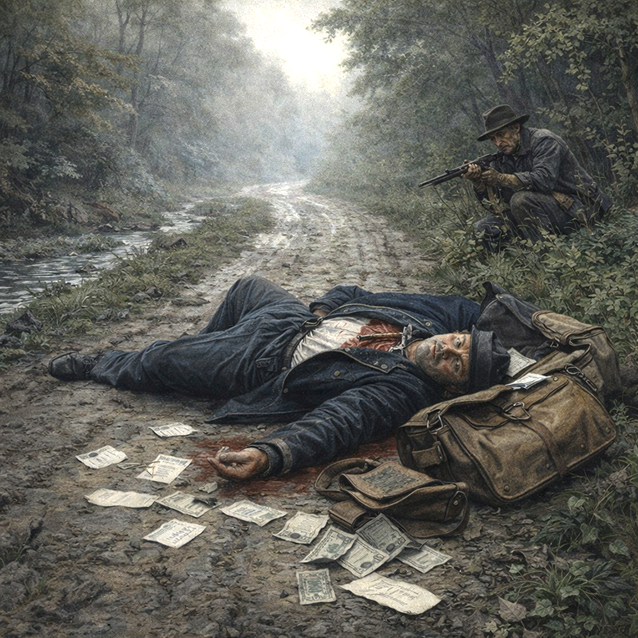
On a lonely stretch of road near the Beachly mine—trees thick, creek close—John Maus stepped out with a rifle and fired from ambush. Brown fell instantly on the road he had traveled for years. Maus rifled the mail, took the moneybag, and vanished into the underbrush.
A Community Responds in Somerset County
Word traveled faster than the mail ever had.
Miners dropped dinner buckets. Farmers loaded shotguns. The Somerset County sheriff formed a posse and brought in bloodhounds. Lanterns bobbed along the banks of Whites Creek through the night. Men who had known Brown for decades moved through the woods in silence, grief sharpened into purpose.
Maus fled into Maryland and made the mistake common to guilty men: he spent money as if it didn’t matter. In Cumberland, an officer noticed the nervous manner and unexplained cash. Somerset County Detective Wagner arrived, and the identification was immediate. Some of the stolen money was still on him and he had already squandered the rest.
Trial, Execution, and the Last Hanging in Somerset County
The trial moved quickly. The evidence was straightforward. Maus insisted he was innocent. The jury disagreed.
On December 16, 1912, the verdict came back: guilty as charged. The sentence was death by hanging.
On October 7, 1913, John Maus was executed inside the Somerset County jail—the last hanging ever conducted in Somerset County, Pennsylvania.
The Harrison Brown Memorial Near Confluence
The rural letter carriers of Somerset County refused to let Harrison Brown fade into a footnote of local history. They raised funds for a monument.
On June 17, 1928, carriers gathered near the spot along Whites Creek where he had been killed. They sang hymns and ministers spoke. A congressman addressed the crowd. Brown’s granddaughter unveiled a bronze tablet set into native sandstone—simple, steady, permanent.
The road has changed. The creek has changed. The world has changed.
The monument remains.
A Jail That Kept Its Secrets
Somerset County Jail and the Legacy of the Maus Case
In 1960, my junior high class from Meyersdale, Pennsylvania, toured the Somerset County jail—an “educational experience” few school boards would approve today.
The sheriff led us through cells and fingerprinting rooms, then up a narrow staircase to a heavy wooden structure that seemed wildly out of place.
“This,” he said, resting a hand on the beam, “is the gallows.”
We froze.
Inside the Somerset County Gallows
He explained that the last execution in Somerset County had taken place right there. The trapdoor, the lever, the beams, even the rope were still intact—preserved with the same sober practicality that keeps barn tools hanging long after their usefulness ends.
At thirteen, I took it as a story.
I had no idea I was standing inside one.
A Hidden Letter from 1913
Twenty years after the execution of John Maus, the Somerset County jail offered up another strange artifact.
In 1932, a prisoner noticed a thin string dangling from a crevice in a cell wall. He pulled, and out fell a hard little wad. Inside was a letter folded to the size of a walnut and packed in finely ground glass—pulverized from a smashed lightbulb, deputies later concluded. Fine enough to swallow.
The letter was dated May 13, 1913.
It had been written by a clergyman who ministered to Maus in his final months.
Sheriff Clifford Saylor took possession of it, and staff recognized the cell as the one Maus had occupied.
Why hide it? Why the glass?
No one knows for certain.
A Puzzle Assembled Backward
At thirteen, I stood in the Somerset County jail and listened to a story about a hanging. I did not know I was standing inside a puzzle.
The pieces arrived, out of order and years apart.
No one handed them to me in order.
It took sixty-five years, the luck of running across two old newspaper articles and the memory of a junior high school field trip to assemble the whole story.
© 2025 Clyde Housel. All rights reserved.
This work may not be reproduced, distributed, or transmitted in any form without prior written permission from the author, except for brief quotations in reviews or scholarly works.
Explore More from Confluence and the Youghiogheny Valley
This story is part of a growing collection of accounts from Confluence, Pennsylvania and the surrounding valley—where memory, record, and place continue to intersect.