The Day the River Turned to Iron – The Homestead Strike of 1892
Before dawn, the Monongahela was still doing what it had always done, sliding past the mills, carrying fog and reflection, indifferent to ownership. But on the morning of July 6, 1892, the river became a corridor of intent.
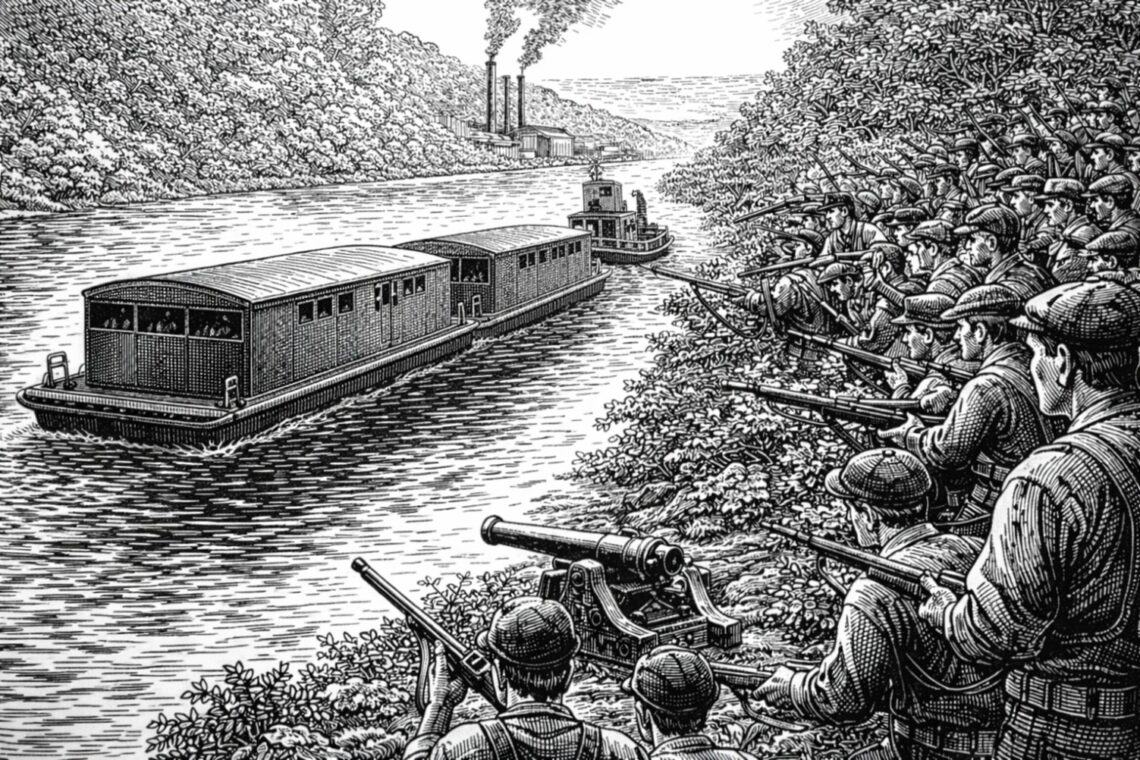
At four o’clock, two barges appeared below Homestead, pushed upriver by the small steamer Little Bill. They carried nearly three hundred Pinkerton guards, hired quietly, moving through the dark with rifles stacked beneath tarps and boots muffled on planks. The plan was simple: land at the Carnegie Steel Works, secure the mill, and reopen production without the men who had locked the gates behind them.
The town was already awake.
Word traveled faster than steam. Men poured down from streets and hillsides, from boarding houses and kitchen tables, from the quiet places where strike committees had been meeting for weeks. By the time the barges touched the bank below the mill, the river’s edge was lined shoulder to shoulder.
No one agrees who fired first. Everyone remembers the sound.
From the barges came rifle fire, sharp and enclosed. From the bank came answering shots—some aimed, some wild, some fired by men who had never held a gun before that morning. Smoke drifted low over the water. The river flattened the noise and sent it back again.
The Pinkertons tried to land. A plank was pushed out. Men rushed it. The plank was pulled back. Another attempt followed, then another. Each time, gunfire drove them down. Bullets splintered the pilot house, punched through wood and glass, ricocheted through cabins and engine spaces. Men fell on both sides; some struck where they stood, others crawling for cover, dragging the wounded back behind barrels and boilers.
By afternoon, the riverbank had become a firing gallery. The barges were pocked with holes. Men aboard were bleeding faster than they could be tended. Eventually, white flags went up—shirts tied to sticks, waved weakly above the gunwales.
At five o’clock, the firing stopped.
© 2026 Clyde Housel. All rights reserved.
This work may not be reproduced, distributed, or transmitted in any form without prior written permission from the author, except for brief quotations in reviews or scholarly works.