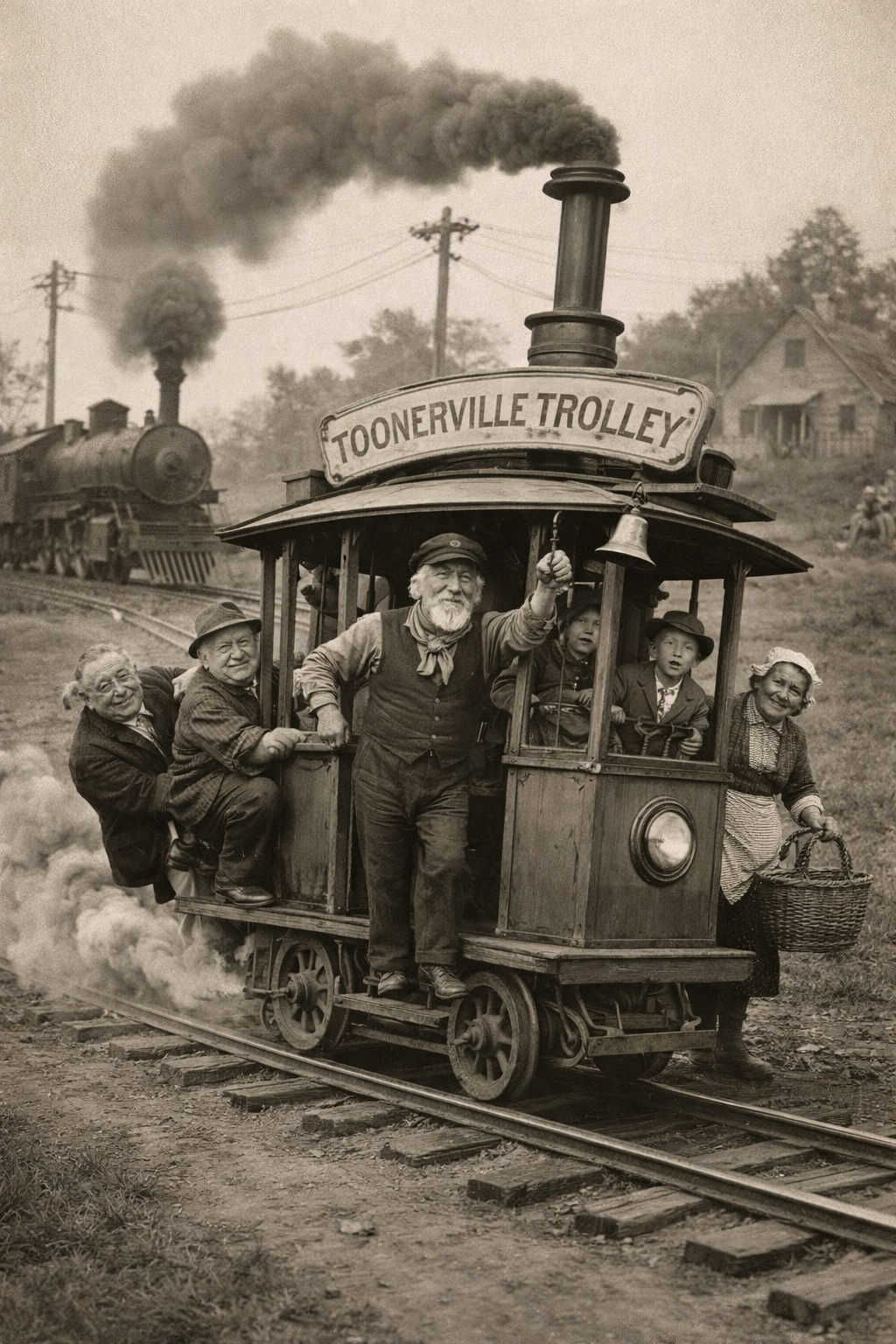
The Toonerville Trolley
The Toonerville Trolley was once a familiar symbol of small-town American life—part transportation, part comedy, and part community legend. Made famous through early 20th-century cartoons and real-life rural rail lines, it captured something both practical and slightly absurd about how people got around. My own understanding of it didn’t come from history books, but from watching it take shape in memory, story, and imagination.
It started as a joke and ended up as a kind of time capsule. It began on paper, in Fontaine Fox’s long-running newspaper feature Toonerville Folks—also known, tellingly, as “The Toonerville Trolley That Meets All the Trains.” The strip started in 1908 and ultimately ran until 1955, which is an almost comically long life for a gag premise. Fox’s Toonerville was a small-town/suburban world of oddballs and habits, where the days felt familiar enough to be true, but skewed just far enough to stay funny.
At the center of it all was that rickety trolley: a little streetcar that behaved like a nervous animal and a determined employee at the same time. The trolley’s job—“meet all the trains”—sounds reasonable until you imagine it in practice. Commuter trains arrive on their own schedule, with their own importance, and the trolley must hustle to keep up. That is the whole comic engine: modern life thundering in on iron rails, and a smaller, more human, more chaotic machine trying to sync itself to the bigger machine without getting flattened.
Fox gave the trolley a driver, the Skipper, who wasn’t a sleek transit professional so much as a whiskery, stubborn captain of a landlocked ship. Fox later described being inspired by a “rattletrap” streetcar he saw at a station near Pelham, New York, complete with a “wistful old codger” of a crewman—proof that the trolley wasn’t just a cartoon contraption, but a recognizable type from the real, transitional America of the early 1900s.
What makes the Toonerville Trolley endure isn’t merely slapstick. It’s the way it captures a historical mood: the awkward overlap between eras. Streetcars and trolleys were once symbols of progress—electric, efficient, urban. But Fox’s trolley is the opposite of sleek. It lurches, careens, and somehow gets the job done through personality rather than engineering. In other words, it behaves like communities often behave when “progress” arrives: everyone is expected to keep up, and they do—barely—by improvising.
The cast around the trolley made Toonerville feel populated rather than plotted. Fox created a parade of characters with names that sound like small-town nicknames you’d hear at a feed store or a church supper—Suitcase Simpson, the Powerful Katrinka, the Terrible Tempered Mr. Bang, and others. The trolley gives them a shared stage: it’s the town’s moving front porch, the rolling gossip line, the place where everybody ends up together whether they intended to or not.
Like a lot of popular newspaper creations, Toonerville didn’t stay confined to the page. It became a kind of early multimedia franchise before anyone used that phrase. There were silent film adaptations in the early 1920s—seventeen of them—scripted by Fox, with the Skipper as a screen character and Katrinka looming large as well. Later, animation took its turn: Van Beuren Studios produced Toonerville cartoons in 1936, including one titled Toonerville Trolley, which essentially turns the trolley’s daily run into a chain reaction of obstacles—gravity, hills, passengers, interruptions—modern life as a physical comedy.
And then there’s the afterlife that says something about nostalgia and collecting: Toonerville Trolley toys and tinplate versions appeared early and have been reproduced and traded ever since, often tied to that same charming idea—something mechanical that wobbles forward anyway.
So what is the Toonerville Trolley, really?
It’s a comic strip centerpiece, yes. But it’s also a metaphor that still lands: the small local thing trying to coordinate with the big official schedule; the human-scale world trying to make connections in an age that keeps accelerating. The trolley “meets all the trains” the way people meet deadlines, obligations, family expectations, and the relentless arrivals of the day—sometimes with grace, sometimes with panic, often with a lurch and a near miss, and somehow, with everybody aboard.
That’s why the Toonerville Trolley doesn’t feel dated even though the trolley era largely is. It’s not about streetcars. It’s about the comedy—and the tenderness—of trying to keep up, together, in a world that doesn’t slow down just because your little vehicle rattles.
© 2026 Terry Housel. All rights reserved.
This work may not be reproduced, distributed, or transmitted in any form without prior written permission from the author, except for brief quotations in reviews or scholarly works.