The Morning the Vineyard Turned Black
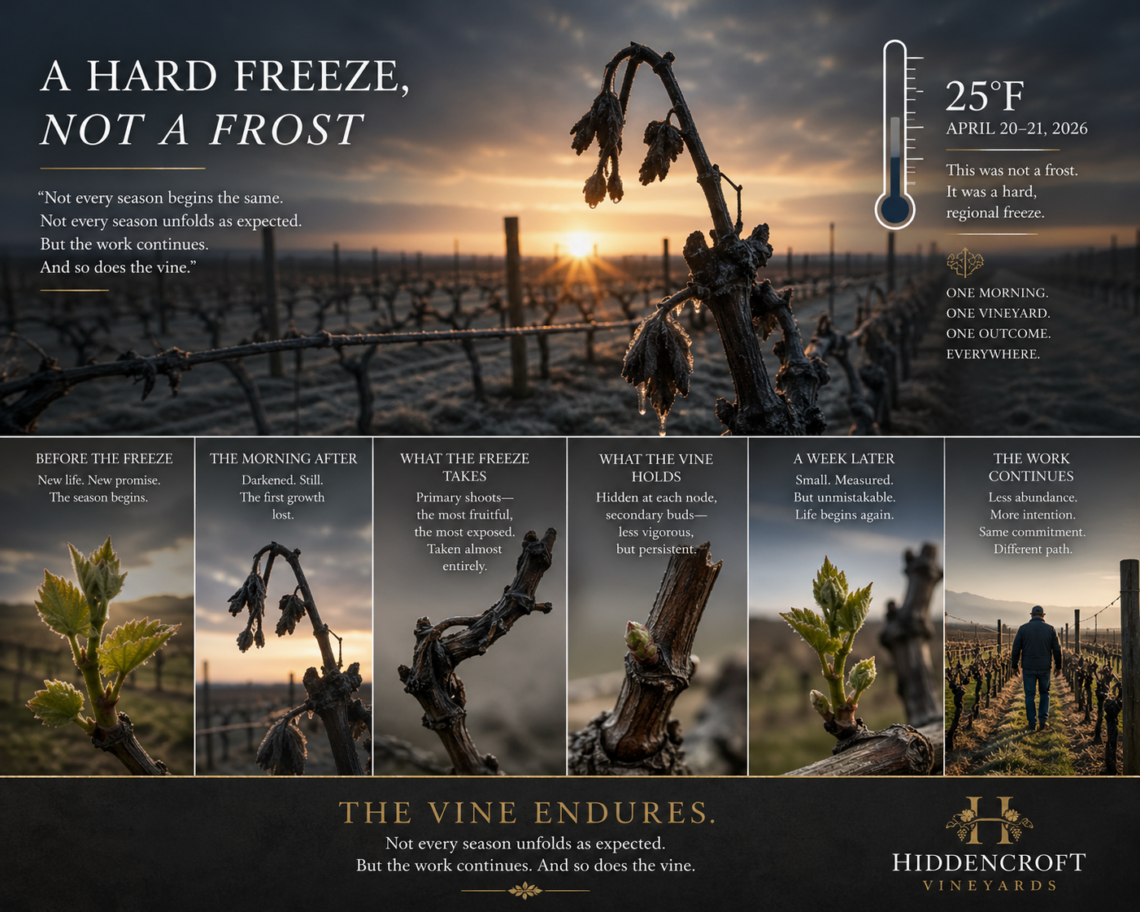
A Hard Freeze, Not a Frost
There are mornings in the vineyard that feel like a continuation of the day before—
and then there are mornings that divide a season in two.
April 20-21, 2026, was the latter.
Just days earlier, the vines had crossed that quiet threshold growers wait for each spring. Buds had opened. Leaves had unfurled. The vineyard had taken on that first soft green that signals the beginning of a new vintage.
It felt as though the season had begun in earnest.
Then, overnight, the temperature fell far enough—and stayed there long enough—to do more than settle frost on the ground. The low we measured at our vineyard was 25.
This was not a frost.
It was a hard, regional freeze.
Frost and Freeze: A Difference of Degree—and Consequence
A frost is often local and uneven.
Cold air settles into low spots. Pockets of the vineyard may be touched while others are spared. With frost, there are often edges—places where the damage stops and the vineyard continues.
A freeze is different.
A freeze is not selective. It arrives with broader reach and holds long enough to penetrate beyond the surface. Instead of pockets, it leaves uniformity. Instead of edges, it leaves a single, shared outcome across rows, slopes, and elevations alike.
Where frost might mark a vineyard, a freeze can redefine it.
On that morning, the vineyard spoke with one voice. The shoots hung darkened and still, not here and there, but everywhere.
What the Freeze Takes
In grapevines, the first growth—the primary shoots—carry the season’s promise. They are the earliest, the strongest, and the most fruitful.
They are also the most exposed.
A light frost may damage some of them. A freeze, arriving after full bud break, takes them almost entirely.
What had been a vineyard in motion became, overnight, a vineyard paused.
The color drained from the rows. The energy that had been pushing upward was suddenly absent. The sense of forward movement—so visible just the day before—was gone.
What the Vine Holds in Reserve
And yet, the vine is not finished.
Hidden at each node are secondary buds—less vigorous, less fruitful, but persistent. They are not the vine’s first intention, but they are its second.
In the days following a freeze, the vineyard waits.
Then, slowly, almost reluctantly, it begins again.
New shoots emerge where the first ones failed. They are fewer. They are later. And they carry less certainty. But they carry life forward.
Recovery Is Not Repair
After a frost, a grower may adjust selectively—pruning here, thinning there, working around what remains.
After a freeze, the approach is different.
There is little to salvage from the first growth. The work becomes one of rebalancing the entire vine:
- Dead primary shoots are removed
- Secondary growth is encouraged and managed
- Expectations are reset early, not gradually
There is no restoring the original season. There is only shaping what comes next.
Recovery, in this case, is not repair. It is adaptation.
A Smaller Year, A Different Year
A freeze narrows a vintage.
Yields are reduced—often significantly. Ripening is delayed. The structure of the crop changes from the very beginning.
Some varieties may produce only lightly. Others may struggle to complete the season at all. And yet, as always, the outcome remains uncertain until the very end.
There are years that build momentum.
And there are years that ask for patience.
This will be the latter.
Why our Cellar Matters
Moments like this bring clarity to something that can be overlooked in generous years: the quiet importance of a well-kept cellar.
A bottle is more than the result of a single harvest. It is a way of carrying one season into another.
When one year falters, another stands ready.
In that sense, a cellar is not simply storage—it is continuity across uncertain seasons.
At Hiddencroft Vineyards, that continuity becomes part of how we move forward.
The Work Continues
The vineyard does not abandon the season, and neither do those who tend it.
The work shifts. The focus narrows. Each decision carries more weight.
There is less abundance to manage—but more intention required.
And Still, the Vines Grow
A week after the freeze, there are signs.
Small, measured, but unmistakable.
New shoots appear. Not as bold as the first. Not as numerous. But present.
And that is the quiet truth the vineyard returns to, again and again:
Not every season begins the same.
Not every season unfolds as expected.
But the work continues.
And so does the vine.



One Comment
Anna Hamilton
Have you ever made dandelion wine?