
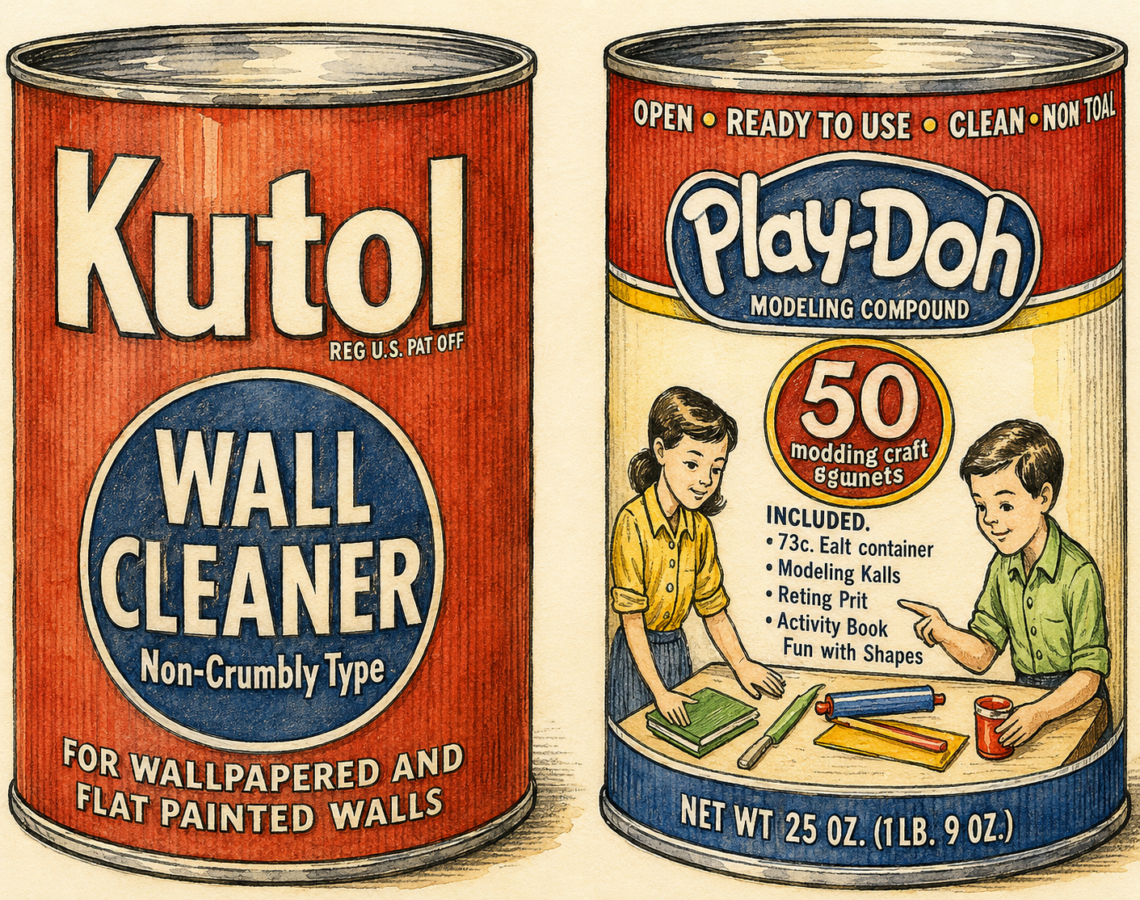
From Wallpaper Cleaner to Play-Doh
A Small Piece of American History
Some of the most enduring American products were never meant to be what they became. Their stories are less about invention than about adaptation—about noticing what still works when everything else has changed. Few examples capture this better than the transformation of a struggling wallpaper cleaner into what the world now knows as Play-Doh.
In the 1930s, a Cincinnati-based company called Kutol Products Company produced a soft, pliable compound designed to clean soot from wallpaper. Coal furnaces were common in American homes, and they left a fine layer of residue on walls that ordinary cleaning methods could not remove. Kutol’s product worked by pressing the dough-like substance against the wallpaper, lifting away the soot without damaging the surface. It was simple, effective—and for a time, essential.
But by the 1950s, the world had changed. Cleaner-burning fuels replaced coal, vinyl wallpaper became easier to wash, and the demand for wallpaper cleaner collapsed. Kutol found itself with a product—and a factory—on the brink of irrelevance.
The turning point came not from the cleaning industry, but from a nursery school classroom. A teacher discovered that the compound, when stripped of its cleaning agents, was soft, non-toxic, and remarkably easy for children to shape. It didn’t dry out quickly. It didn’t stain. It held its form just long enough to encourage imagination. What had once lifted soot from walls now sparked creativity in small hands.
Recognizing the opportunity, Kutol reformulated the product, added bright colors and a mild scent, and reintroduced it to the market—not as a cleaner, but as a toy. In 1956, Play-Doh was born.
What followed was not just commercial success but cultural permanence. Play-Doh became a fixture in classrooms, kitchens, and childhoods across the country. It crossed generations without losing its appeal, remaining almost unchanged in its essential qualities: soft, simple, and open-ended. It asked nothing of the user except imagination.
There is something distinctly American in this story—not just the ingenuity, but the willingness to pivot without sentimentality. A product designed for one purpose quietly became something else entirely, not through grand design, but through observation and necessity. The factory did not close. The material did not disappear. It simply found a new life.
And perhaps that is why the story endures. It reminds us that usefulness is not fixed, that failure can be a form of transition, and that sometimes the most lasting creations begin as something else altogether—something practical, ordinary, and nearly forgotten.