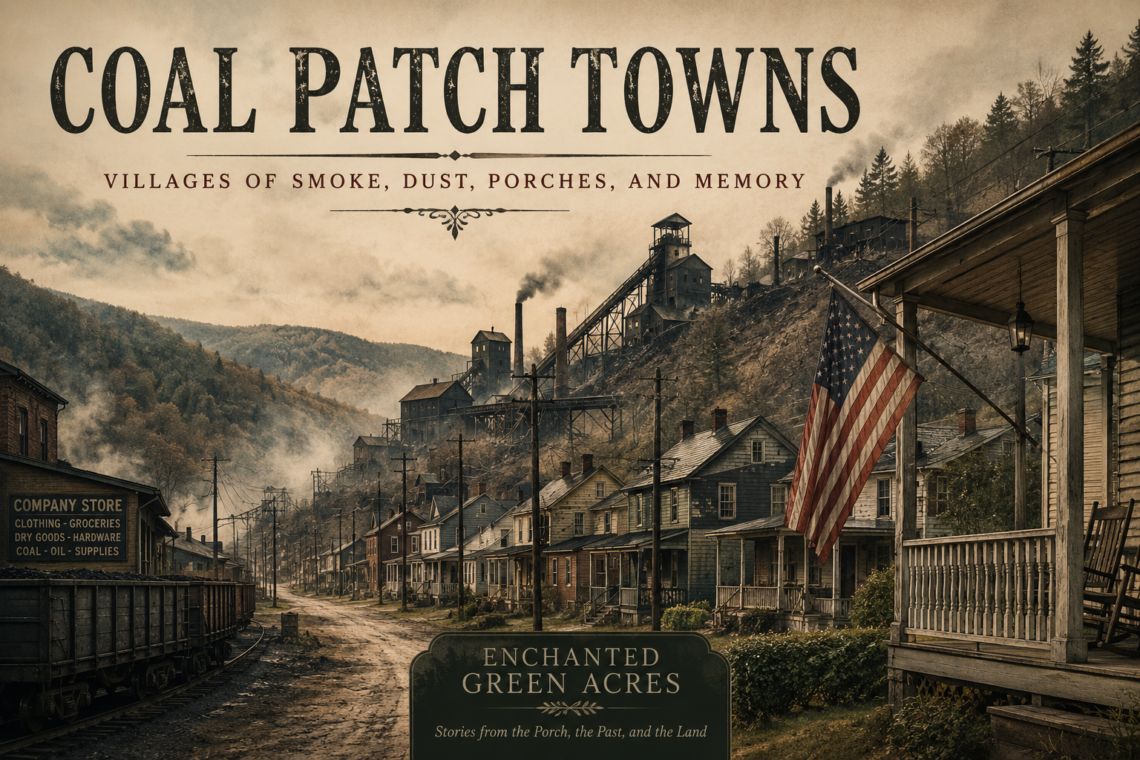
Coal Patch Towns
Villages of Smoke, Dust, Porches, and Memory
There are places scattered through the hills of Pennsylvania, West Virginia, Maryland, Virginia, and eastern Ohio where the landscape still behaves strangely.
A line of lilac bushes bloom in the middle of the woods. Stone steps rise toward nothing. A rusted pipe emerges from a hillside and disappears again beneath ferns. An old pear tree flowers every spring beside a foundation that vanished before many living people were born.
If you grew up in Appalachia, or spent enough time listening to older people, you eventually learn what these places are.
A coal patch town used to stand there. Not a town in the ordinary sense.
A patch. A settlement built quickly beside drift mouths, rail spurs, coke ovens, breakers, and tipples by coal companies racing to pull black rock from beneath the mountains faster than the industrial world could consume it.
For a time, these towns stretched across Appalachia like soot-darkened beads threaded through valleys and hollows. Some contained only a few rows of company houses. Others held schools, churches, boarding houses, baseball fields, union halls, and entire neighborhoods divided by language, nationality, religion, and occupation.
Today many have nearly disappeared. But the memory of them has not.
Towns Built Faster Than Comfort
Coal patch towns were rarely planned for beauty or permanence. They were built for production.
Rows of company houses climbed muddy hillsides close enough together that neighbors could hear arguments through open windows in summer. Laundry snapped between porches. Coal dust settled onto curtains, gardens, bread dough, and babies sleeping near screened doors.
Yet despite the hardship, people transformed these rough settlements into communities with astonishing speed.
Flower beds appeared beside brick sidewalks. Italian families planted tomatoes and grape arbors.
Women scrubbed porch railings with fierce determination while miners came home blackened from the shafts and sat quietly beneath the evening light.
Children raced barefoot through cow paths carrying marbles in their pockets.
And somewhere, almost always, a radio played baseball through an open window.
The Front Porch Civilization
Coal patch towns were porch cultures. Not because people were nostalgic. Because the porch was necessary.
The houses were small. Summers were hot. Air conditioning did not exist. Men worked underground all day and wanted air after supper. Women wanted company while snapping beans or shelling peas. Grandparents wanted to watch the road. Children wanted to stay outside until darkness finally forced them in.
So life moved outward.
In the evenings, entire rows of porches filled at once.
Women talked across yards.
Men glided on porch swings silently after shift change.
Neighbors waved at passing cars not because they were unusually friendly, but because acknowledgment itself was part of belonging.
In many coal towns, everybody knew everybody’s business anyway.
The porch merely provided a front-row seat.
And somehow, despite gossip, feuds, drunkenness, layoffs, explosions, union arguments, and overcrowding, these places often developed extraordinary social cohesion.
If a miner was killed, food appeared.
If a family lost their house, neighbors rebuilt it.
If somebody got sick, collections were taken before anyone asked.
Coal patch towns could be rough.
But they were rarely indifferent.
A World Built from Many Countries
One of the greatest misunderstandings about Appalachia is the idea that it was culturally isolated or uniform.
Coal towns prove otherwise.
The mines drew immigrants from everywhere: Italy. Sicily, Poland, Germany, Scottland, and Ireland.
Entire hillsides echoed with overlapping languages. A child might hear six accents before breakfast and think nothing of it.
Food crossed ethnic boundaries faster than prejudice sometimes did.
Spaghetti appeared beside sauerkraut.
Pierogies beside cornbread.
Homemade wine beside soup beans.
The smell of coal smoke mixed with garlic, cabbage, tobacco, fresh bread, and damp work clothes drying beside kitchen stoves.
Coal patch towns were industrial communities.
But they were also accidental cultural experiments.
Children of the Patch
Children who grew up in coal towns often describe those years with an unsettling mixture of danger and enchantment.
The landscape itself became a playground.
Railroad tracks,
Creeks-stained orange with sulfur runoff, abandoned drift openings, slate piles, rusting machinery, and coal tipples.
Today, adults would panic at the thought of children wandering such places unsupervised.
Back then, it was simply called afternoon.
Entire generations grew up exploring industrial ruins without realizing they were walking through the collapsing machinery of America’s first great energy empire.
Many later described those childhoods as magical.
Not because life was easy.
Because the world felt alive with mystery.
Every old miner carried stories.
Every abandoned structure suggested hidden history.
Every hillside seemed to contain ghosts.
The Sound of a Coal Town
Coal patch towns had their own acoustics.
Steam whistles before daylight. Coal cars coupling in the dark. Dogs barking from chained yards.
Screen doors slamming all summer long. Train whistles echoing through valleys at night.
And always the steady murmur of voices traveling porch to porch beneath the glow of bare bulbs.
Even silence sounded different there.
When mines closed, former residents often said the first thing they noticed was not unemployment.
It was quiet.
The Slow Vanishing
Coal towns rarely disappeared all at once.
They dissolved.
First came layoffs.
Then families moved away.
Then schools consolidated.
Then the stores closed.
Tracks were removed.
Tipples collapsed.
Nature reclaimed the edges; sumac, goldenrod. Blackberries, and birch trees growing on creek banks.
Today some former patches survive only as:
- Rock foundations and cellar holes
- cemeteries
- old photographs
- newspaper clippings
- remembered surnames
- and stories repeated across kitchen tables long after the towns themselves disappeared
Yet emotional geography remains remarkably durable.
People whose families left these places generations ago still speak of them with startling intensity.
Not because the towns were perfect.
But because they belonged to them.
Why Coal Patch Towns Still Matter
Coal patch towns helped build industrial America.
The coal pulled from Appalachian hills heated cities, powered railroads, fueled steel mills, and helped construct bridges, factories, skyscrapers, and warships across the nation.
But their deeper significance may be human rather than industrial.
These towns created generations shaped by:
- hardship
- interdependence
- labor conflict
- ethnic blending
- improvisation
- humor
- storytelling
- resilience
And perhaps that is why so many stories still emerge from them.
Stories about explosions.
Stories about floods.
Stories about ghosts.
Stories about railroad wrecks.
Stories about impossible winters.
Stories about strange neighbors and tougher grandmothers.
Because places built around dangerous work tend to produce rich oral histories very quickly.
Coal patch towns were never merely collections of company houses.
They were entire emotional ecosystems.
And though many are fading into forests now, the memory of them still lingers quietly throughout Appalachia — in accents, recipes, photographs, porches, graveyards, and the uneasy feeling that sometimes settles over a hillside where a town used to be.
Explore More from Enchanted Green Acres
Coal Towns & Appalachian Life
- The Ghosts of Shaw Mines
- Front Porch Culture 101
- Kitchen Culture 101
- The Shaw Mines Au Pairs
- One Sister’s Journey
- The Coal Town Powerhouse
Railroads, Industry & Transformation
- From Coal to Trail
- What Is Coke Used for in Steelmaking?
- The Town Along the Great Allegheny Passage That Surprised Me Most
- The Day the River Turned to Iron
Memory, Humor & Regional Voices
The Mail Carrier on Whites Creek
When the Newspapers Had More Fun Than Their Readers
David Cronin and the Turkeyfoot Valley