The Unintentional Sheep Farmer
How a Simple 1892 Sheep Purchase Became Part of the Compher Farm’s Lasting History
In 1892, western Loudoun County still moved at the pace of feet, wagons, and livestock. The roads were little more than rutted dirt tracks between stone fences, and a trip of three miles on foot was simply considered an afternoon errand.
That was how John W. Compher and his five-year-old son Charles Compher found themselves walking across the fields toward Morrisonville one warm afternoon in search of sheep for the family farm.
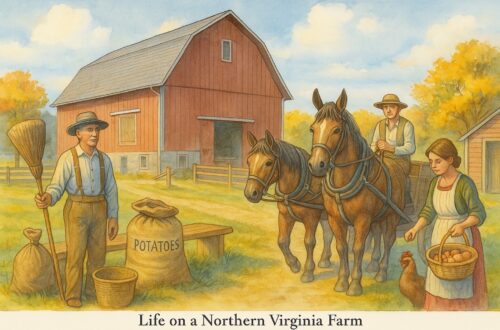
The Compher farm, like many farms in western Loudoun, was expected to produce whatever the family might need—corn, hay, vegetables, milk cows, hogs, chickens, and now, perhaps, sheep. Whether John W. had carefully planned to become a sheep farmer or had merely been persuaded by a neighbor with livestock to sell is no longer known. Farm histories are often built more from necessity than strategy.
By midafternoon the bargain had been struck with the traditional firmness of the era: a handshake between men who expected a person’s word to hold greater value than paper. Young Charles, who had spent much of the day wandering around the pasture staring at the animals, watched as the small flock was gathered.
“Are we heading home now?” he asked eagerly, assuming the long walk was finally over.
His father glanced toward the lowering sun and shook his head.
“We’ll wait till dusk,” he said. “Cooler for the sheep then.”
So they waited.
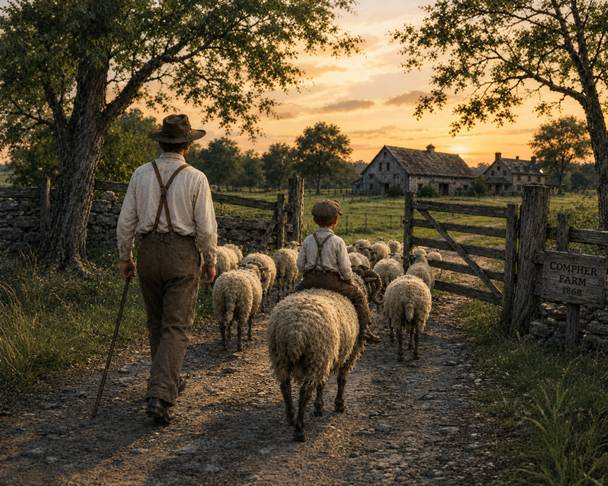
As evening settled over the Loudoun Valley, father and son finally started westward again, driving the sheep slowly through the fields toward the Compher farm. The animals shuffled and wandered as sheep do, nibbling at weeds and occasionally refusing to cooperate entirely. John W. walked patiently behind them with a hickory stick in hand while little Charles trudged beside him in growing exhaustion.
For a while the boy tried to keep pace without complaint. But somewhere along the darkening fields between Morrisonville and home, his legs began to fail him.
“Papa,” he finally said, “why didn’t the man loan us one of his horses to ride home? He had plenty of them.”
John W. looked down at his tired son, then over toward the large buck sheep walking stubbornly near the edge of the flock.
“Well,” he said thoughtfully, “do you reckon you could ride that buck?”
Charles immediately straightened.
“Yes sir.”
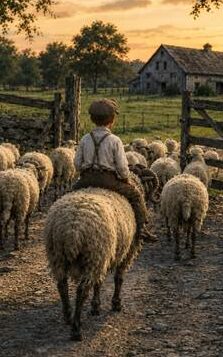
Whether John W. expected the idea to succeed is doubtful. But the boy marched directly over to the animal, grabbed hold of the thick wool and mane around its neck, and awkwardly climbed aboard.
To everyone’s surprise except perhaps Charles’s own, the buck tolerated the arrangement.
And so, as dusk settled over western Loudoun County in 1892, five-year-old Charles Compher rode home toward the family farm astride a buck sheep while his father walked beside the flock trying unsuccessfully to hide his amusement.
More than a century later, while reading through the old Compher farm ledgers in 2026, the story suddenly gained an unexpected continuation. The books showed entries recording lambs born each spring and the steady growth of the sheep herd in the years that followed. What may have begun as a small practical purchase slowly became a substantial part of the farm itself.
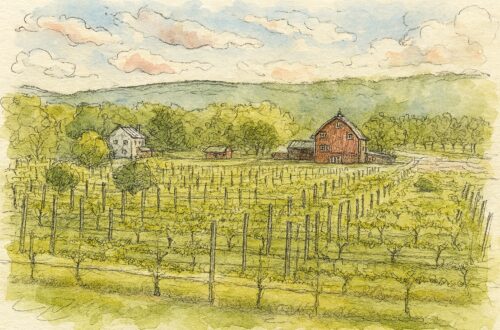
By 1930, Charles had grown and inherited the property. The flock had become large enough to require dedicated quarters inside the great Pennsylvania-style bank barn. To accommodate them, Charles altered one side of an old feeding trough. He cut away the V-shaped wooden slats and fashioned a long, low feeder that stretched across the width of the earthen barn floor. This allowed the sheep to feed together indoors during winter weather.
That improvised trough still remains inside the barn today.
Most visitors would walk past it without noticing.
But once you know the story, it becomes something else entirely. It is a surviving artifact of the evening a tired five-year-old boy rode a buck sheep home across the Loudoun fields and unintentionally helped begin the Compher farm’s sheep herd.
33Note: This is a true story told by Charles Elbert Compher, himself when he was 100 years old. It was related to Eugene M. Scheel , Loudoun County Historian, on July 1, 1977 at the home of Mr. Compher in Brunswick, Maryland. The interview was conducted as an oral history project. The original is located in the Thomas Balch Library in Leesburg, Virginia.