
What Was a Harvest Home?
For most of human history, bringing in the harvest was not simply another item on the calendar.
It was a matter of survival.
Grain standing in a field could still be lost to rain, wind, animals or rot. Fruit left too long could spoil. Hay had to be cut and dried. Vegetables needed gathering. Meat would eventually need curing or smoking. Winter was coming whether the farm was ready for it or not.
So, there was a moment each year when the last important crop had finally been brought safely home. And that moment deserved celebrating.
In Britain, the tradition became known as Harvest Home.
Its roots stretch back centuries. Harvest Home marked the completion of the harvest and traditionally brought workers, landowners, families and neighbors together for food, drink, music and celebration. Harvest songs were sung. Tables were filled. Ale was poured. After weeks of exhausting work dictated by weather and daylight, people could finally stop and enjoy themselves.
English settlers carried versions of those customs across the Atlantic, and harvest celebrations became part of life in colonial America, including Virginia.
The details changed with place, crop, wealth and circumstance. There was no single official “Harvest Home menu,” nor did every Virginia farm celebrate in precisely the same way. But the idea would have been easily understood…
The harvest is safely gathered. There is food enough. Winter can come. Tonight we celebrate!
That last part can be difficult for us to fully appreciate.
Today, a poor harvest may mean higher prices at the grocery store or fewer local peaches at the farm market. In earlier centuries, crop failure could threaten a family’s livelihood and sometimes its survival.
A full smokehouse, barrels of flour and meal. Apples stored in a cellar, vegetables preserved in crocks, hams hanging in the smokehouse and jars of preserves represented something more important than picturesque country living.
They meant Security. They meant there would be something to eat in February.
That is one reason harvest celebrations were joyful. The feast wasn’t merely celebrating abundance. It celebrated relief.
The work had succeeded. The provisions were in. The household was prepared.
The old tradition of Harvest Home celebrated the successful end of another growing season. But what happens when the growing season doesn’t end quite as successfully as everyone had hoped?
That is the story of Hiddencroft’s 2026 harvest.
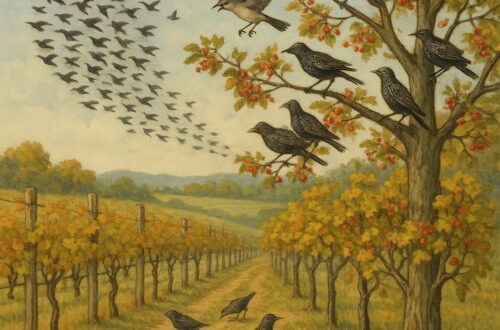
This spring, an unusually damaging freeze arrived after our vines had already begun to grow. Cabernet Franc, Petit Verdot, Tannat and much of the vineyard lost the crop that ordinarily would have become this year’s harvest. A few hardier vines managed to produce something, but compared with a normal year, our harvest baskets will be decidedly light.
In the grand scheme of things, we know how fortunate we are that our loss was only grapes.
Still, it left us with a question: What do you do when you’ve planned a harvest celebration and Mother Nature neglects to provide the harvest?
We could cancel it. Or we could celebrate anyway. We chose the latter.
And thus was born Hiddencroft’s “No Harvest” Harvest Dinner.
Perhaps farmers of earlier generations would understand that decision better than we might imagine. Harvest celebrations were certainly expressions of gratitude for abundance, but agriculture has never promised abundance. Farming has always meant living with frost, drought, flood, insects, disease and countless other reminders that we may cultivate the land, but we never entirely command it.
Some years the barn is full. Some years it isn’t.
And that is why the old idea of Harvest Home seems especially appropriate this year. A harvest was about more than the quantity brought in from the fields. The celebration marked the completion of another agricultural year—the work accomplished, the provisions put away, and the moment when families, neighbors and workers could finally gather around a table together.
That seems worth celebrating in a good year or a difficult one.
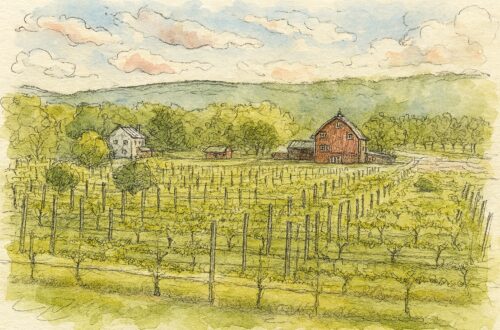
So although our 2026 grape harvest may fit comfortably into considerably fewer baskets than we would have preferred, the vineyard remains. We have wine from more generous harvests, a barn in which to gather, good food to put on the table, and another growing season behind us.
And that is more than enough reason for a Harvest Dinner