Beneath the Mountain and Beyond the Coal Patch
Why a Second Edition of The Ghosts of Shaw Mines?
When The Ghosts of Shaw Mines was first published, I believed I had told the story I had set out to tell—the story of the vanished coal-mining community where I grew up and of the people whose lives were intertwined with the mines beneath it.
But the story wasn’t quite finished.
My return to the site of Elk Lick No. 2 allowed me to see something I could never have seen as a boy: the inside of the mountain itself. Modern surface mining had exposed remnants of the underground workings that had lain hidden for more than a century. Collapsed tunnels, surviving pillars of coal, mine timbers and the remains of a coal car gave physical form to things I had previously known largely through memories, old maps and records.
At the same time, further research made it increasingly clear that Shaw Mines could not be fully understood in isolation. Its story was part of a much larger landscape of coal patches, railroad towns, mines and families whose lives crossed the boundaries between individual communities. The Second Edition Expanded reaches beyond Shaw Mines to explore those neighboring places, their connections to Shaw Mines, and the forces that eventually caused many of them to disappear or change beyond recognition.
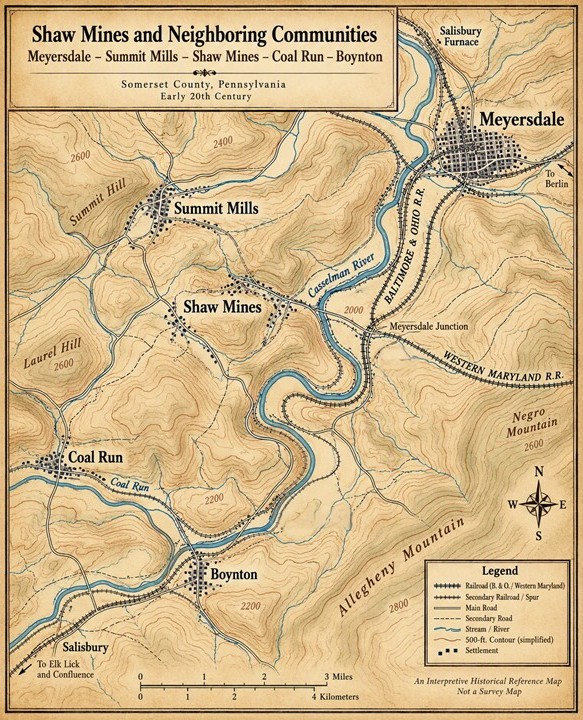
The result is a broader story than the one told in the First Edition. It still begins with the memories of a boy who grew up at Shaw Mines, but it now looks beneath the mountain and beyond the boundaries of the coal patch to place Shaw Mines within the larger world of which it was once a part.
When the Mountain Gave Up Its Secrets: A Return to Shaw Mines and What the Mountain Revealed
In September 2026, I returned to Shaw Mines under circumstances I could never have imagined as a boy. With permission to enter the active surface-mining operation now working the site of the old Elk Lick Number 2 Mine, I went back to see whether the modern excavation had exposed any physical trace of the underground mines that operated there during the early 1900s. I made the visit after the regular mining crew had finished for the day, when the great machines were mostly quiet and the opened mountain could be studied up close and personal. My guide was the 90-year young, lifetime resident of the area, Perry Yoder.
Securely strapped into his rugged Polaris 4-wheel drive vehicle, we climbed the mountain strip mine roads and descended into the pits. From the first view, the scale of the excavation was difficult to absorb. The pit resembled a vast, terraced quarry, descending through benches of sandstone, shale, and coal.
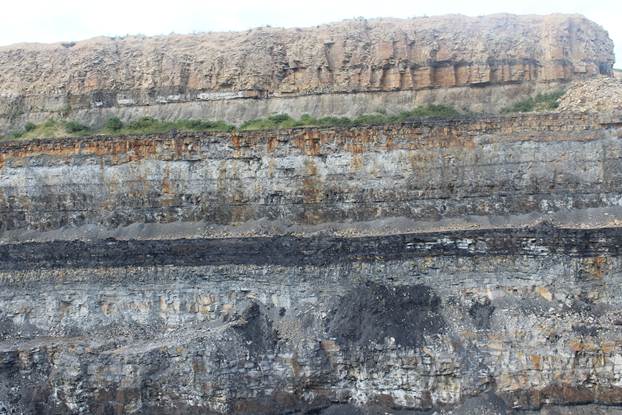
Surface Mining High Wall at old Elk Lick Number 2 Mine Site
Roads broad enough for modern haul trucks wound along the walls. The tipple, mine cars, and narrow-gauge tracks of the old operation were gone, replaced by loaders, excavators, and machinery capable of moving entire sections of the mountain. Across the exposed highwall, the rock strata formed a geological cross-section millions of years in the making.
The highwall clearly revealed not one coal seam, but several. The Pittsburgh seam was clearly visible with the Redstone and Blue Lick seams also exposed in places. Dark bands of coal ran through the lighter layers of rock, separated by substantial intervals of shale and sandstone. What I had once known only from mine maps, geological records, and the recollections of miners now stood exposed in daylight. The mountain had been opened deeply enough to display the coal-bearing structure beneath the place where I once roamed as a boy.
More remarkable still, the old underground workings were unmistakable. Along the highwall were numerous collapsed mine tunnels from the early 1900s deep-mining operation.
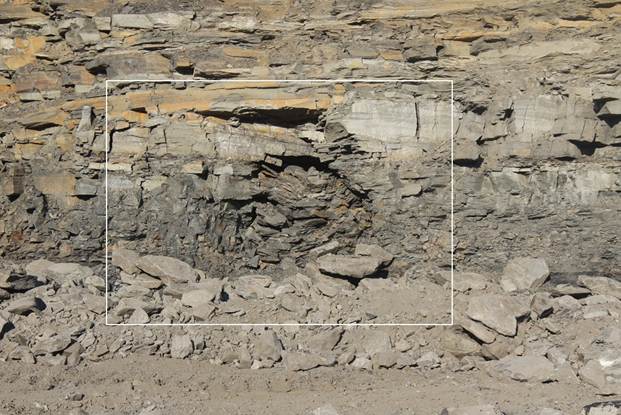
Collapsed Mine Tunnel- Elk Lick Number 2 Mine
They did not appear as neat, open doorways leading into darkness. Their roofs had fallen, and the spaces were filled with broken, jumbled material that did not follow the orderly bedding of the undisturbed rock around them. Against the regular horizontal strata, these collapsed zones were obvious interruptions—visible scars left by rooms that miners had opened more than a century earlier.
The Image below is an AI interpretation of what the Mine tunnel may have looked like before collapse.
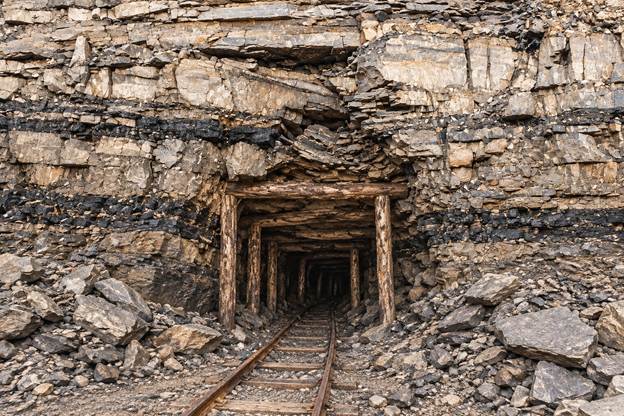
The wall also displayed what the miners called coal ‘stumps’: masses of coal left standing when the surrounding seam was removed. Some appeared to be remnants of the pillars that had once supported the mine roof. There, in the highwall, was the physical geometry of room-and-pillar mining laid bare—the mined rooms now collapsed and filled, and portions of the supporting coal still present between them. What had seemed abstract on an old mine map could now be seen in the mountain itself.
The Labyrinth Beneath Shaw Mines
For years, the old mine maps had presented something of a mystery to me. Their intricate room-and-pillar patterns—passages branching and turning, rooms opening beside other rooms, and blocks of coal deliberately left standing between them—formed an underground labyrinth beneath the familiar landscape of Shaw Mines. I could trace those workings on paper, but I had never truly been able to picture what they represented inside the mountain. My return to Elk Lick No. 2 changed that. In the exposed highwall, the collapsed openings showed me where some of those rooms and passages had actually been, while the surviving coal stumps revealed the pillars the miners had left behind to support the roof. The recovered timbers and remnants of the coal car added still another dimension, helping me visualize how men, animals, and equipment had moved through that hidden network. For the first time, the maze of lines on those old maps began to take on physical form.
Two discoveries brought the human scale of the old mine especially close. Excavation had uncovered the remnants of an early-twentieth-century coal car, a battered survivor of the system that once, pulled by horses and mules, carried coal through the underground passages.
From Artifact to Reconstruction
Only fragments of this coal car survived more than a century underground.
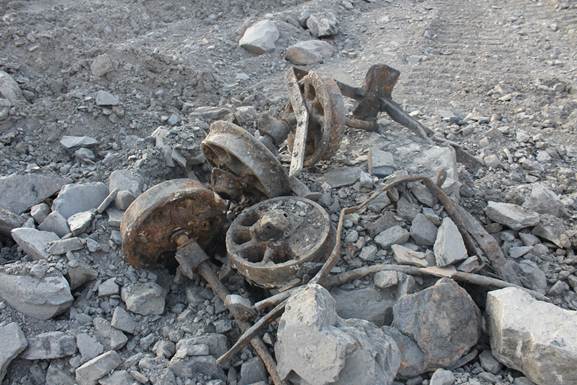
Artifacts of Coal Car unearthed at Elk Lick Mine Number 2
Using photographs of those remains as the starting point, AI was used to visualize what the complete car might once have looked like. The resulting image incorporates features consistent with an early-twentieth-century wooden mine car, but where the archaeological evidence is incomplete, AI necessarily supplied interpretive details. It should be viewed much as one would view an artist’s historical reconstruction: evidence-based where evidence survives, and conjectural where it does not.
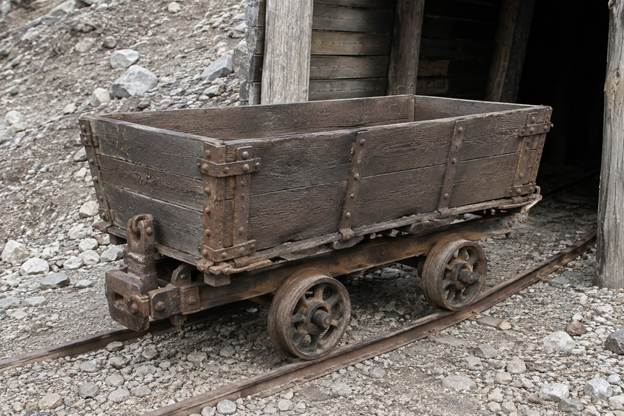
AI Constructed Image of Coal Car Based upon Artifacts Recovered
The amount of coal remaining at Shaw Mines was another surprise. The earlier deep mines had removed a great quantity, but they had not exhausted the deposit. Substantial reserves remain in and around the old workings, and estimates indicate that the present surface operation could continue for as long as thirty more years. The modern mine is therefore not merely clearing away the remains of an exhausted coal field. It is recovering coal left behind by the earlier methods and reaching seams and sections that the old underground miners could not—or did not—remove.
Several support timbers had also been removed from the old tunnels.
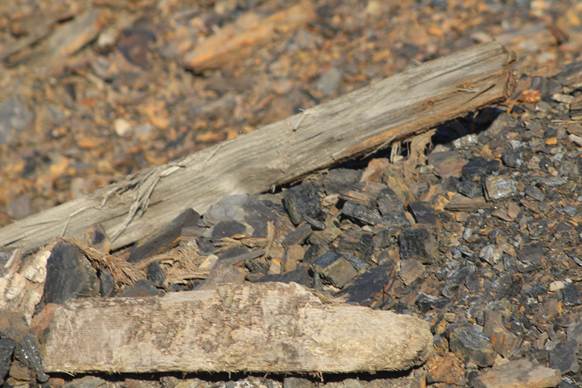
Timbers once used for Shoring Roof of Elk Lick No. 2
Despite having remained underground for more than one hundred years, they showed no obvious decay. Protected within the mine, those timbers had endured long after the houses, tipples, tracks, and other structures on the surface disappeared.
Those timber artifacts would have been part of the roof shoring system used to reinforce unstable ceilings in the mine rooms and tunnels of the Elk Lick Number 2 Mine.
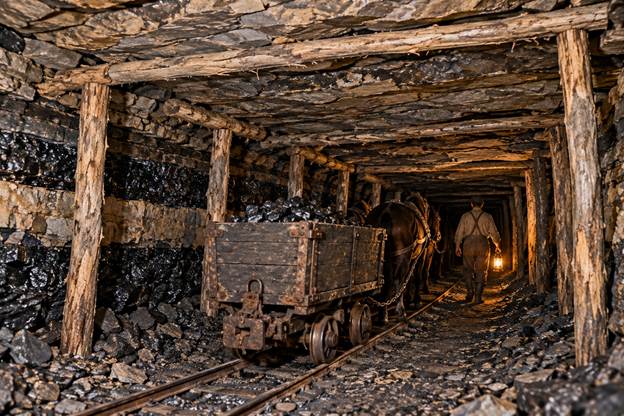
AI Reconstruction of How the Artifact Timbers Would Have Been Used in the 1910 Mine Tunnel
Even after the regular crew had left, the work of the modern mine had not entirely stopped. One excavator operator and two truck drivers remained, removing topsoil and setting it aside.
That soil will be preserved for reclamation after the recoverable coal has been taken. The mountain was opened for extraction, but its living surface is carefully saved so that the land can someday be shaped and covered again.
The high wall held several histories at once. Its regular bands recorded the ancient formation of the Pittsburgh, Redstone, and Blue Lick seams. The collapsed tunnels and coal stumps bore witness to the labor of the early miners, while the unearthed coal car and preserved timbers recalled the men and machinery that once moved through those rooms. The broad benches and immense excavation revealed the power of present-day surface mining, and even the stockpiled topsoil pointed toward a future landscape, after the mining has ended and reclamation has begun.
I had gone to Shaw Mines hoping the mountain might surrender some recognizable evidence of the underground world shown on the old maps. Instead, it opened that world plainly before me: the seams could be traced across the wall; breached passages and surviving pillars mapped the lost workings; and objects last handled by miners more than a century ago had been brought again into daylight. What maps and records could only describe now stood before me as tangible remnants of the place where the people of Shaw Mines had labored.
The visit could not restore the vanished coal patch. Surface mining continues to alter the ground, just as underground mining altered it before. But for one evening, the opened mountain revealed the hidden half of the hill I had known as a boy. Beneath the woods, fields, and slate piles had lain a vast network of rooms, pillars, timbers, tracks, and coal cars—a world I had walked above without comprehending its form or scale. More than a century after those tunnels were dug, I was able to look upon what remained. I had returned in search of ghosts and found their enduring traces written in coal, stone, timber, and iron.
Clyde F. Housel

You May Also Like
A Kitchen Full of Starlings

When Butter Tastes Like Onions
