First Grade in a Coal Patch Town: Inside a 1950s Rural Schoolhouse
From Coal Stoves and Outhouses to Chromebooks and Constant Connectivity
Today’s classrooms hum with quiet efficiency. Rows of students are behind screens and lessons are guided by digital platforms. But there is a growing undercurrent of strain that many teachers carry long after the final bell rings.
The outside world—once held at bay during school hours—now flows freely through devices and expectations that never quite switch off. Discipline is negotiated. Attention is divided.
But it wasn’t always this way…
There was a time when the school itself felt rooted in the land. It was less engineered, more improvised. Learning shared space with coal dust, creek water, and whatever wildlife happened to wander in uninvited. Order came not from policy manuals, but from presence. And childhood unfolded with a kind of unfiltered immediacy that feels almost foreign now.
The following excerpt, from The Ghosts of Shaw Mines, captures a slice of 1950s rural school life, where education, environment, and childhood collided in ways that were unpredictable, uncomfortable—and unforgettable.
Excerpt: First Grade at S.J. Miller School
The S.J. Miller School was a two-story, four-room wooden structure that, to an aspiring first grader, looked like a towering, haunted house, complete with a bell tower. I followed in the footsteps of seven older siblings, who thoroughly prepared me for this day.
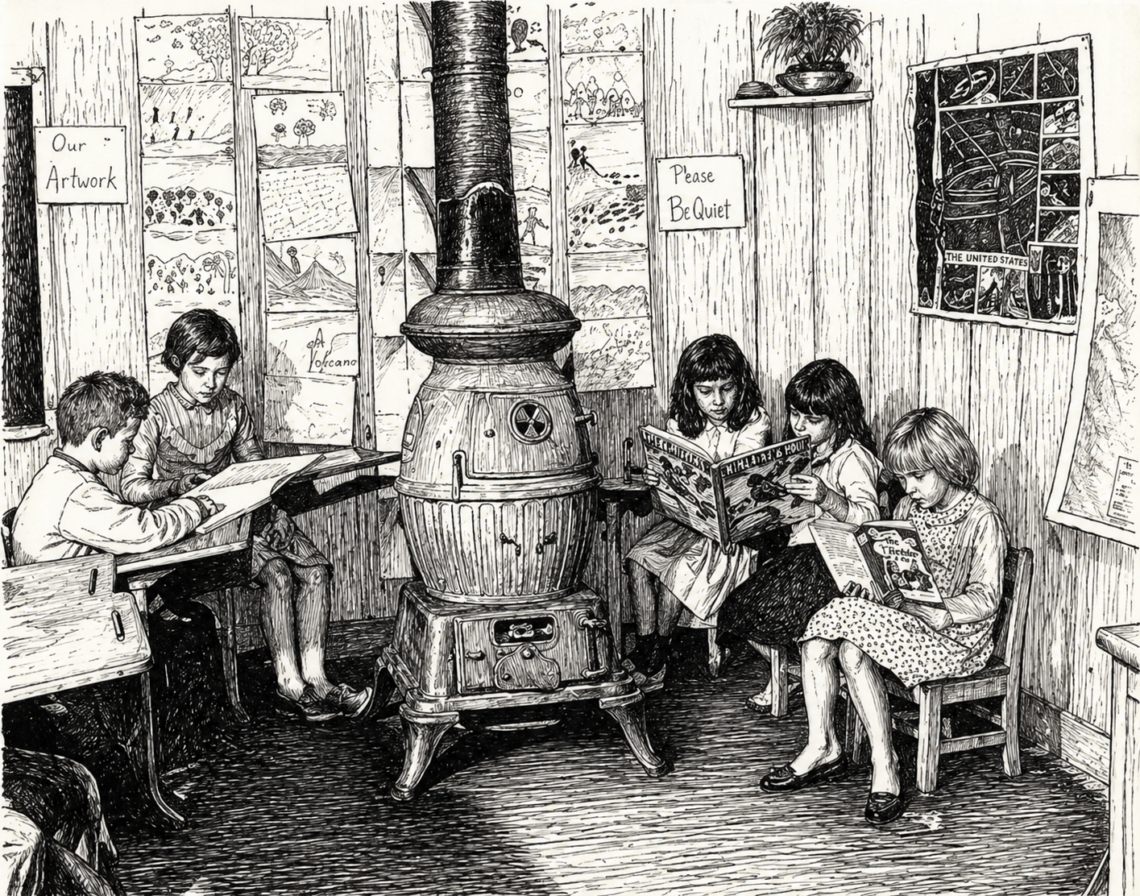
Each classroom was equipped with a huge coal stove that had the unique ability to either freeze your back or roast your front, depending on your seating arrangement. The boys’ and girls’ toilets were located in separate wooden outbuildings stationed behind the school.
A small creek ran beneath the playground, funneled through a four-foot-high metal culvert, which served as the closest thing we had to an amusement park. Drinking water was pumped by hand from a well, meaning that hydration required patience and upper body strength. Thirsty elementary students stood in line holding expandable metal cups as the older boys manned the stubborn pump handle.
One rainy day, our stomping and singing during indoor recess disturbed a mouse. It shot out from beneath the wooden floor in a panic and scrambled up Norman Yoder’s pant leg and onto his shirt. Art Slayton, in a gallant attempt to save his classmate, swatted wildly at Norman’s back, making the whole affair look like a cross between an exorcism and a barn dance.
Order, however, was quickly restored when the mouse escaped back down its hole—and the teacher retook control.
Another time, our teacher, Miss Bear, in reaction to a misbehaving class, retrieved a large wooden paddle from the blackboard tray.
Immediately, we transformed into a class of angels.
A Different Kind of Order
There were no tablets. No behavior frameworks. No carefully worded interventions.
Just a room full of children, a teacher who meant business, and a world that had not yet learned to soften itself.
And yet—despite the rough edges—something held.
Then vs. Now: What Changed?
Physical hardship and simplicity defined the 1950’s classrooms. Mental load and constant connectivity shape the classrooms of today.
- Then: limited resources, but clear authority
- Now: abundant tools, but fractured attention
- Then: school stayed at school
- Now: it follows teachers and students home
Somewhere between those two worlds lies the story of how teaching became one of the most complex professions in modern life.
Closing Thought
The classroom has changed. Dramatically. But the central tension remains the same: how to guide a room full of young minds through a world that refuses to sit still.
Somewhere between the coal stove and the Chromebook…that work continues.