
How Artificial Intelligence Will Reshape the Teaching Profession
There are moments when a profession changes gradually, almost without notice. And then there are moments when something shifts so fundamentally that it becomes clear, even in real time, that the old model will not hold.
Education has entered one of those moments.
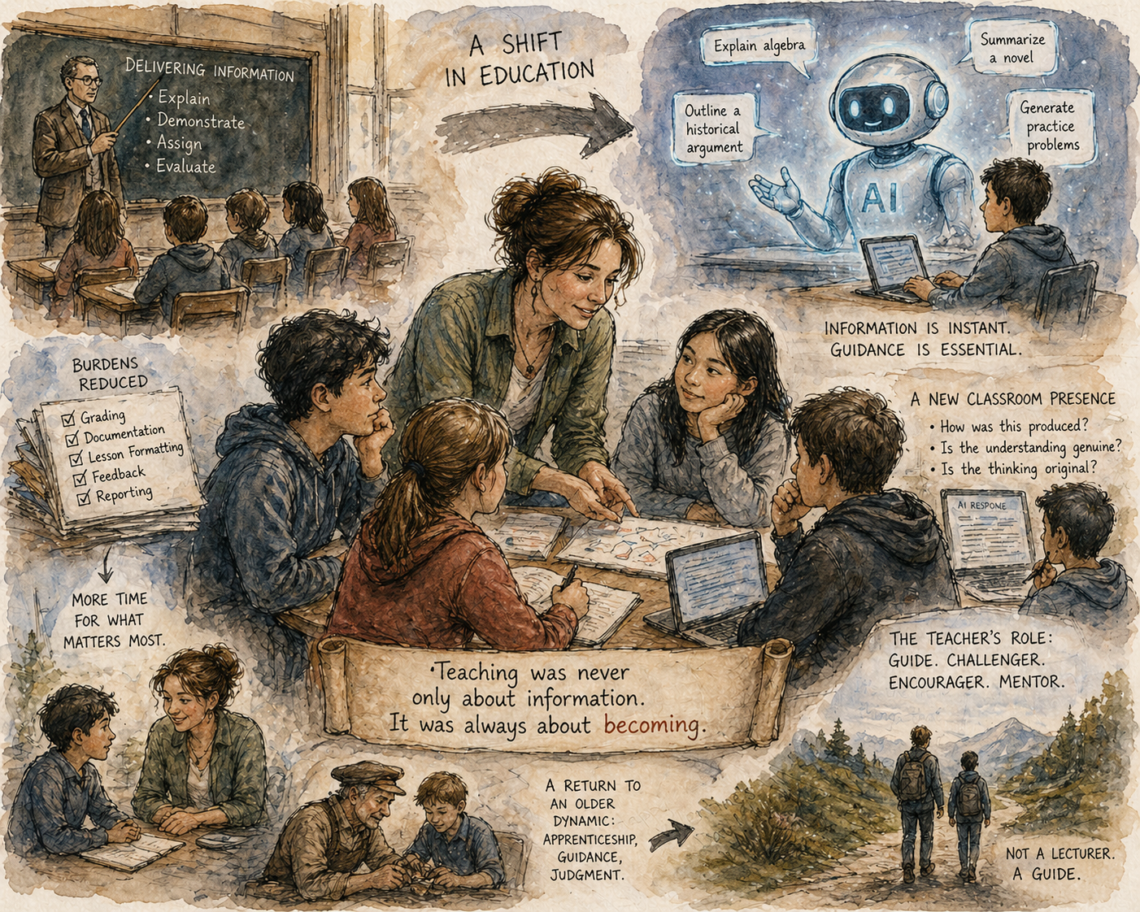
For generations, the structure of teaching has been built around a simple premise: the teacher is the primary source of knowledge in the room. Lessons are designed to deliver information. Assignments are structured to measure how well that information has been absorbed. The teacher explains, demonstrates, assigns, and evaluates.
Artificial intelligence is beginning to loosen that structure.
A student can now ask a machine to explain algebra, summarize a novel, outline a historical argument, or generate practice problems tailored to their level. These tools are not perfect, but they are improving quickly—and they are always available. The classroom is no longer the only place where structured learning happens, and the teacher is no longer the only voice explaining the material.
This does not eliminate the need for teachers. But it does change what students need from them.
From Delivering Information to Guiding Understanding
As access to information becomes immediate and abundant, the value of simply delivering it begins to diminish.
In its place, something more complex emerges.
Students will need help learning how to think—how to evaluate what they are given, how to recognize when something is incomplete or incorrect, how to ask better questions, and how to connect ideas across subjects. Artificial intelligence can provide answers. It cannot, at least not reliably, teach judgment.
The teacher’s role shifts accordingly.
Less time is spent explaining what something is. More time is spent asking whether it makes sense. Less emphasis is placed on arriving at an answer. More emphasis is placed on understanding how that answer was reached, and whether it holds up under scrutiny.
In this environment, the teacher becomes less of a lecturer and more of a guide—someone who has gone a little further down the path and can help others navigate it.
The Quiet Disappearance of Certain Burdens
Much of the strain in teaching has never come from the act of teaching itself. It has come from everything surrounding it.
Grading. Documentation. Lesson formatting. Repetitive feedback. Administrative reporting.
Artificial intelligence is particularly well-suited to these tasks.
It can generate lesson drafts, suggest feedback, analyze patterns in student performance, and assist with routine evaluation. Used carefully, it has the potential to reduce the time spent on mechanical work and return some portion of a teacher’s day to the classroom itself.
That does not make the profession easier. But it may make it more focused on its central purpose: working directly with students.
A New Kind of Classroom Presence
At the same time, artificial intelligence introduces something new into the room.
Students will increasingly arrive having already interacted with AI. Some will use it as a tool for learning. Others will use it to bypass the work entirely. Most will fall somewhere in between.
This creates a new layer of complexity.
The teacher must now discern not only what a student has produced, but how it was produced. Is the understanding genuine? Is the work assisted? Is the thinking original, or assembled?
The presence of AI becomes something like an unseen participant—useful, powerful, and occasionally misleading.
Managing that presence becomes part of the profession.
The Changing Identity of the Teacher
Perhaps the most significant shift will not be procedural, but personal.
For a long time, teachers have been defined, in part, by their expertise. They knew the material. They explained it clearly. They evaluated whether others had understood it.
When machines can perform many of those functions instantly, the foundation of that identity begins to move.
What remains—and what becomes more visible—is the human side of teaching.
The ability to recognize when a student is struggling, even when the work appears correct. The instinct to encourage at the right moment. The judgment to challenge when it matters. The capacity to see potential before it is obvious.
These are not new qualities. They have always been part of the profession. But they have often been overshadowed by the mechanics of instruction.
Artificial intelligence may strip some of that away and leave the essential work more clearly exposed.
A Return to an Older Model
In some ways, the future of teaching may resemble its past.
Before modern systems of schooling, learning often occurred through apprenticeship. A student worked alongside someone more experienced, observing, practicing, receiving correction, and gradually developing skill and judgment.
The relationship was not built primarily on the transfer of information. It was built on guidance.
Artificial intelligence may allow education to move, at least in part, back toward that model—within the structure of modern classrooms.
The tools are new. The dynamic is not.
What Will Not Change
For all that may shift, certain things are unlikely to disappear.
Students will still need encouragement. They will still struggle with uncertainty. They will still require discipline, structure, and the occasional push to do work they would rather avoid.
They will still look to someone in the room—someone fully human—for signals about what matters and what does not.
Not because the system is simple. Not because the work is light. But because there is something in the act of guiding another person’s development that remains difficult to replace.
And teachers, for their part, will still return.
Emotional intelligence. It was there before and it isn’t going anywhere.
The Shape of What Comes Next
Artificial intelligence will not end the teaching profession.
But it will reshape it.
The teacher of the future may spend less time delivering information and more time cultivating judgment. Less time grading and more time observing. Less time managing content and more time guiding people.
The work will remain demanding. But the demands will shift.
And in that shift, something may become clearer than it has been for a long time:
Teaching was never only about information.
It was always about becoming.




2 Comments
Verna
We enjoyed the articles. Please continue writing the newsletter. Can you also write some more poems and include them. I really like the ones in the book and think that they are very well written. You are a very good poet.
EGA Editor
Thanks for your positive comments. The poems in the book were written by Stacie, Clyde’s daughter. I will pass on your compliments.